
The short answer
Focus calibration is the step in dash cam production where the lens is moved to the position that gives the sharpest image on the sensor and then fixed there. It is done on every unit, not once per batch, because small variations in lens, barrel threads and board position add up. The usual method is to point the camera at a printed resolution chart at a set distance, watch the live picture, turn or slide the lens until the chart lines are crisp, and then lock the lens with adhesive or a locking ring. This is the typical practice described at Shenzhen partner factories; the exact fixture, distance and pass criteria are confirmed for each factory and program.
Why focus is not automatic
Most dash cam lenses have a fixed focus. Unlike a phone, there is no motor that adjusts focus while you drive. The lens barrel sits at one position, set at the factory, tuned for objects from a few meters to infinity, which in practice means the road ahead. If that position is wrong by a small amount, the whole picture is a little soft, and the user blames resolution. A unit with a true 4K sensor and a poorly focused lens can look worse than a 1080P unit that was focused well. That is why the sensor line on a spec sheet only tells part of the story; see true 4K versus upscaled 4K.
How it runs on the line
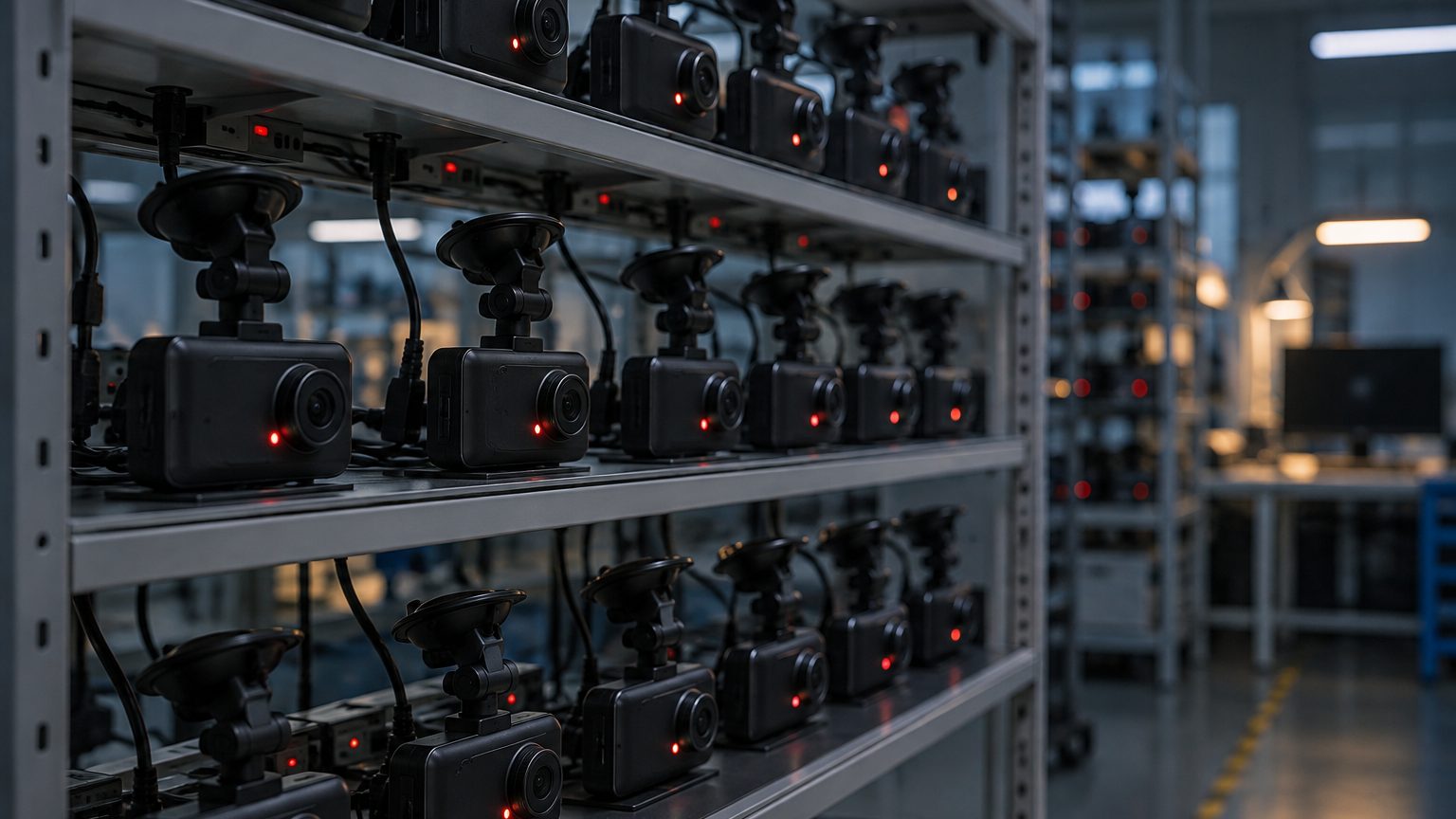
The calibration station is simple in concept. A camera under test is powered, mounted in a fixture facing a chart, and connected to a screen. An operator, or in more automated factories a machine, adjusts the lens while a reading of sharpness is taken at the center and at the corners. When the reading passes the limit, the lens is locked and the unit is marked.
| Element | Purpose | What can go wrong |
|---|---|---|
| Resolution chart | Gives a repeatable target with fine lines | Faded or dirty chart gives false passes |
| Fixed test distance | Keeps every unit judged the same way | Fixture moved, distance changes |
| Lighting | Consistent brightness avoids false readings | Flicker or uneven lamps |
| Center and corner check | Catches tilted lenses | Only center is checked |
| Locking step | Fixes the position permanently | Adhesive not cured, lens shifts later |
| Second check after lock | Confirms nothing moved while fixing | Step skipped to save time |
The failure patterns buyers meet
When focus calibration is weak, the symptoms are recognizable. A batch may have some units that are crisp and some that are slightly soft, which looks like random quality. Corners may be soft while the center is fine, which suggests a tilted lens. Footage may be sharp when the unit is cold and soft after a hot day, which suggests the lens shifted as adhesive or plastic softened. Each pattern points back to a specific part of the process. The point of a buyer review is to turn "some are blurry" into a question the factory can answer, such as whether the corner check exists and how the lock is verified.
Focus and heat
A dash cam sits behind a windshield, often in strong sun. Lens barrels in plastic can expand, and adhesives can soften, so a lens that was sharp on the line can drift after weeks in a hot cabin. Glass lens elements are more stable than plastic ones, and metal barrels or well-chosen adhesives help, which is why heat is an input into material choices covered in the housing note and the lens quality note. For buyers in hot regions, a temperature sampling test that includes a sharpness check afterward is worth requesting. See dash cam heat resistance.
What a buyer can ask
- Is every unit focused individually? The honest answer should be yes, with a fixture photo to show it.
- Are corners checked as well as the center?
- How is the lens locked, and is focus checked again after locking?
- What is the pass criterion? It might be a chart line group that must be resolved; the factory should name it.
- What happens to a unit that fails? It should be refocused or scrapped, not packed.
The same questions fit a sample check. Record a short clip of a printed chart or a distant street sign from three samples of the same model, then compare sharpness across them. If the three differ noticeably, the line has a focus problem, and that matters more than any single sample being good. The sample checklist lists other comparisons worth running at the same time.
Automation and manual work on the station
Focus calibration sits at the boundary between automated and manual production, and factories differ in how much of it is machine-controlled. In a manual setup, the operator turns the lens while watching a live magnified view of the chart, and the judgment of sharpness is human. In a semi-automated setup, a fixture rotates the lens under motor control while software reads sharpness from the image and stops at the peak. Automated versions exist on higher-volume lines. Each has its own failure mode: a human operator gets tired near the end of a shift, a motor fixture can drift out of calibration itself, and software can be fooled by a dirty chart or changed lighting. That is why the fixture itself needs periodic verification, for example by running a known reference unit at the start of each shift and confirming it still passes. Ask whether the line does this. A factory that verifies its fixtures daily will usually answer with a record, not a yes.
What this means for custom lenses
When a program changes the field of view, the aperture or the lens supplier, the focus station has to be set up again: the chart distance, the lighting and the pass criterion are all revisited, because a wider lens or a faster aperture changes where the sharp zone lies. First articles from the new setup deserve a closer look than a routine batch, including corner sharpness and a heat check. This is one of the quieter reasons why a changed lens can disturb a program that seemed otherwise unchanged, and why change control, covered in the defect-rate discussion, names the lens as an item that needs approval before volume.
Where it sits in the whole route
Focus is set after the lens module is mounted and before the housing is closed, because the lens must still be reachable. That ordering also means a unit that fails later in testing may need to be reopened, so factories that do focus well usually have fewer reworked units. The full route is described in how dash cams are made and on the production process page, and the checks the desk makes are on quality control.
For a program with a custom lens or a new field of view, the focus fixture and criteria are set up again for the new module, and the first articles are checked before volume starts. Ask for that in the quote and the desk will write it into the program sheet via the quote form.