
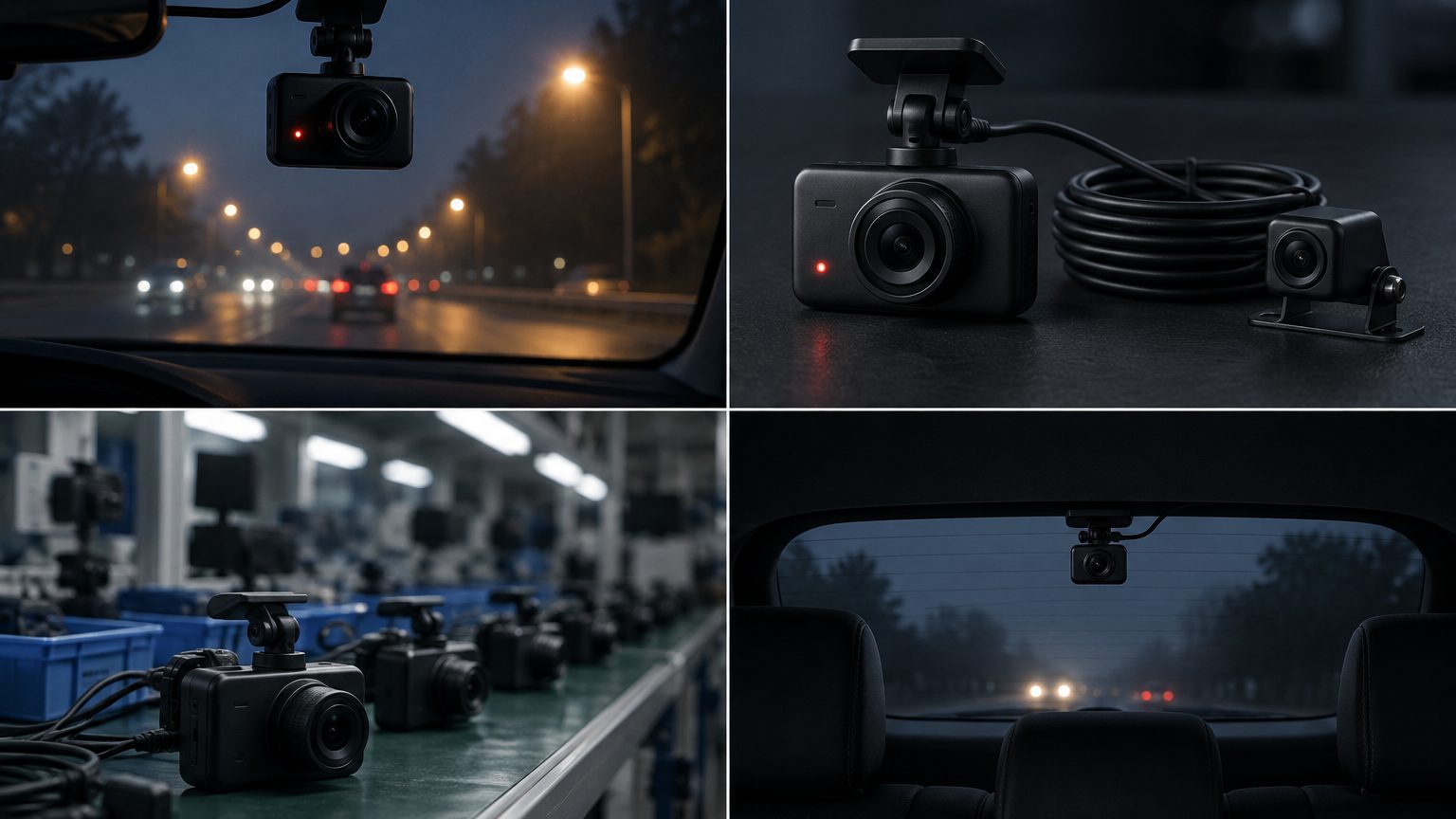
Why dual recording sells
Search demand for front-and-rear dash cams is large and steady, because the evidence buyers care about most is often behind the car: rear-end collisions and parking dents. A dual system records both directions to one card, with time-synced files that are easy to hand to an insurer. For a seller, it is also the line with the clearest step-up from entry models, which makes it the natural hero of a range. See how it compares with other dual setups.
The platform inside
Most 4K dual units in the Shenzhen cluster share a recognizable platform: a Novatek NT96670-class chipset, a Sony IMX415 front sensor for native 3840 x 2160 recording, and a 2-megapixel GalaxyCore GC2053-class rear camera at 1080P. In dual mode many platforms drop the front frame rate below the single-channel figure - a line worth confirming on the spec sheet rather than assuming.
| Spec line | Typical platform | What to confirm |
|---|---|---|
| Front resolution | 3840 x 2160 native (IMX415) | Sensor model, not just "4K" on the box |
| Rear resolution | 1920 x 1080 (GC2053 class) | Cable length for sedans vs SUVs and vans |
| Frame rate | 30fps class; lower in dual mode on some units | Dual-mode frame rate in writing |
| Codec | H.265 on most current platforms | Storage per hour at your settings |
| Power buffer | Supercapacitor | Heat tolerance for hot markets |
| Connectivity | Optional WiFi app, optional GPS | App language list and branding options |
Options that change the program
Three options move both price and paperwork. WiFi turns the unit into a radio device: in the US that means an FCC ID rather than a simple declaration, and in Europe it falls under the Radio Equipment Directive - see certifications. GPS adds speed and location stamps that insurers and fleet managers value. A hardwire kit unlocks buffered parking mode and is often worth bundling; the hardwire kit line covers the low-voltage cutoff that protects the car battery.
Branding and packaging
Private label on this line usually means your logo on the housing and boot screen, your gift box, manual and warranty card. Shenzhen OEM suppliers commonly publish minimums from about 100 pieces per model for logo and packaging work; app branding, firmware changes and new housings are quoted per project. Bundles with a 64GB or 128GB high-endurance card raise basket value and cut first-week complaints about cards that fail under loop recording.
Who buys this line
Three buyer types account for most dual-channel programs. Online and marketplace sellers use it as the hero product of a range, usually bundled with a card and sometimes a hardwire kit, because reviews in this category reward visible rear footage. Distributors and retail chains stock it as the step-up model above an entry unit, which keeps the shelf story simple. Installers fit it for customers who want a clean wired install with parking coverage. Each needs a slightly different package: sellers care about the box and the bundle, retailers about consistent supply, installers about cable lengths and the hardwire kit's cutoff settings.
Common failure points to design out
Most returns on dual systems trace back to a few avoidable causes: a rear cable too short for an SUV or van, a rear camera that fogs or loses focus in summer heat, cards that cannot keep up with two simultaneous streams, and app connection complaints when the WiFi app is poorly localized. Each has a fix that belongs on the spec sheet - cable length by vehicle type, rear-camera sealing and focus check after burn-in, a card class matched to the bitrate, and an app language list confirmed before bulk. Writing these down at sampling stage costs nothing; fixing them after a marketplace review costs a listing.
What the desk checks before shipment
- Image check. Day and night clips from front and rear, plate readability at the agreed distance.
- Function check. Both channels recording, GPS lock, WiFi pairing with the app, G-sensor event lock.
- Burn-in. Continuous recording run per program before packing.
- Packing check. Accessories, cable lengths, manual language and carton marks against the spec sheet.
Reference lead times: stock samples ship in days, custom samples take about 7-15 working days, and bulk on a stock platform typically runs about 15 working days - all confirmed per program on MOQ and lead time. Start with the quote form.