
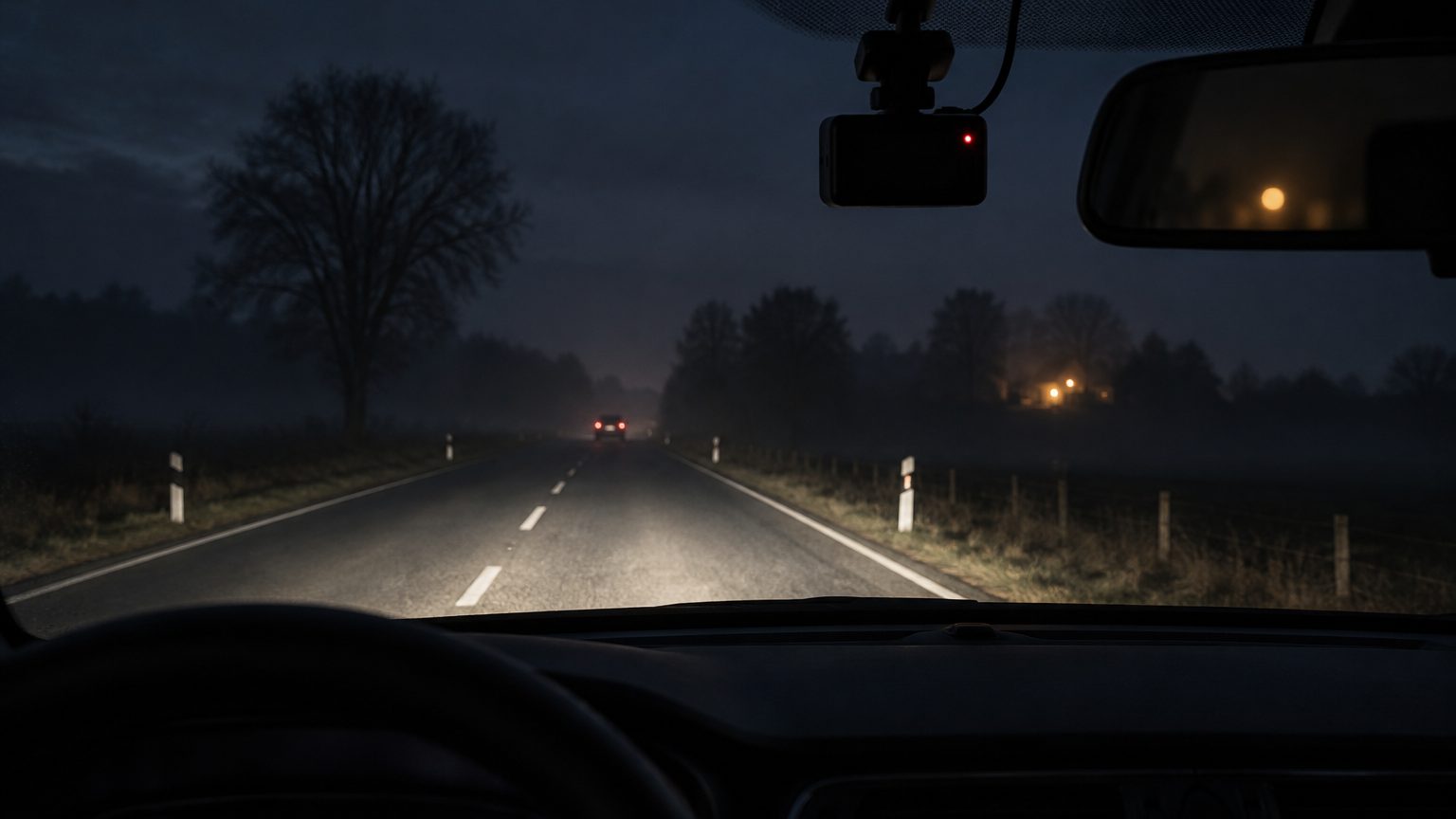
What night vision really means
Most dash cams do not see in the dark. They record better than others when little light is available, and the difference comes from three things: the image sensor, the lens aperture and the tuning in the chipset. A road lit by headlights and streetlights is a low-light scene, not a dark one, and a good low-light unit keeps plates readable under those lights. The other meaning of night vision is infrared illumination, used in cabin cameras to see passengers when the car is dark. The guide to night vision in dash cams covers the limits in plain language.
Sensor, lens and tuning
Low-light performance starts with a sensor from the Sony STARVIS family, which is designed for low-light surveillance work, and newer models use STARVIS 2 parts such as the Sony IMX675. A wide aperture lets more light in, and processing such as noise reduction and wide dynamic range keeps bright lamps from washing out the scene. Wide dynamic range matters at night as much as in daylight, since headlights and dark roads create the same high-contrast problem. See WDR and HDR in dash cams for the glare and tunnel story.
| Factor | What it does | What to confirm |
|---|---|---|
| Image sensor | Sets the low-light limit | Model number from the STARVIS family |
| Lens aperture | Light gathered per frame | Aperture value on the sheet |
| WDR or HDR | Balances lamps against dark areas | Real night clips, not stills |
| Noise reduction | Cleaner dark areas, risk of smearing | Plate readability, not softness |
| Frame rate | Motion blur in low light | Night clip at normal speed |
| IR illumination | Cabin visibility only | Cabin camera model and IR range |
Variants
The line has three practical forms. A front-only low-light unit suits private drivers and night commuters. A dual unit with a low-light front and a 1080P rear covers drivers who also want rear evidence. A rideshare or taxi unit adds an infrared cabin camera so passengers remain visible in the dark, which is covered in the rideshare line. For all, a circular polarizing filter reduces windshield reflections that otherwise show as ghost lights at night.
Who buys it and when
Night-shift fleets, delivery and last-mile operators, taxi and rideshare drivers, and security-minded private owners are the clearest audience. Regions with long dark winter hours and unlit rural roads also buy more on this feature. Online sellers use the line as a quality-tier model with a story that is easy to check: the sensor family and a sample clip. Distributors place it above the entry unit. For delivery and van programs, the desk usually pairs it with GPS; see GPS dash cams.
Common night-footage problems
Three faults account for most complaints. Over-aggressive noise reduction smears plates into soft blobs, so the clip looks clean but cannot be read. A sensor that runs warm in a closed cabin raises noise as the evening drive goes on, which is why a burn-in run matters. And a dashboard reflecting in the windshield adds a ghost image that no sensor removes, which a dark mat and a polarizing filter address. Writing the night test route into the sampling brief lets the desk compare units on the same street and the same lamps, instead of comparing marketing photos.
Customization and certification
Private label on this line covers the logo, box and manual; image tuning profiles can also be set by firmware as part of an OEM program, since the same hardware can be tuned toward brighter or more natural night footage. Shenzhen OEM suppliers commonly publish minimums from about 100 pieces per model for logo and packaging, with firmware changes quoted per project. Certification is the usual route: FCC Part 15 declaration in the US, CE with EMC, low-voltage safety and RoHS in Europe, and FCC ID plus RED if the model carries WiFi. General information only; confirm with a compliance adviser or lab. See certifications.
Buyer checks before ordering
- Night clip. Same street, same route, golden sample against a reference unit; check plates under lamps.
- Glare test. Oncoming headlights, wet road reflections, tunnel exit.
- Heat run. Burn-in before packing so noise does not rise as the sensor warms.
- Cabin check. If IR is fitted, passenger visibility in a dark cabin and IR glare off the windows.
Reference lead times: stock samples ship in days, custom samples about 7-15 working days, and bulk on a stock platform typically about 15 working days, confirmed in writing for each program on MOQ and lead time. Send your brief through the quote form.