
The short answer
A dash cam is built in two halves that meet in the middle. The electronics half starts as a bare printed circuit board that goes through surface-mount technology (SMT), where components are placed and soldered. The mechanical half is the housing, the lens module and the mount. They join at assembly, then every unit gets firmware, a focus adjustment, a functional test and a run-in period before it is packed. The sequence below is the typical route at partner factories in the Shenzhen cluster; each factory has its own variations, and the exact route is confirmed in writing for each program. Roadtrace is a sourcing desk, so the process is described as we coordinate and check it, not as something we run ourselves.
The route in order
The table lists the stations in their usual order, what happens at each, and what a buyer can reasonably ask for as evidence.
| Station | What happens | Evidence to ask for |
|---|---|---|
| 1. SMT | Solder paste printing, pick-and-place, reflow oven, automated optical inspection (AOI) | Photos of the line, AOI sample records |
| 2. Lens module assembly | Lens barrel mounted on the sensor board | Lens and sensor model on the bill of materials |
| 3. Focus calibration | Lens position adjusted against a resolution chart and fixed | Chart setup photo, pass criteria |
| 4. Housing assembly | Board, battery or supercapacitor, buttons and shell joined | Material declaration, fit check |
| 5. Firmware flashing | Version loaded and settings fixed | Version string on the sample |
| 6. Functional test | Record, GPS lock, WiFi pairing, G-sensor, buttons, screen | Checklist per unit or per batch |
| 7. Burn-in | Continuous recording run; duration set per program | Run duration and fail count |
| 8. Temperature sampling | High and low temperature checks on samples, per program | Test conditions in writing |
| 9. Packing | Gift box, accessories, manual, card if bundled | Packing list against the order |
| 10. Carton and inspection | Master carton marking, then pre-shipment AQL sampling | Inspection report |
SMT: where the electronics are born
SMT is the most automated part of the route. Solder paste is printed onto the board through a stencil, a pick-and-place machine sets the chipset, memory, sensor-board connectors, resistors and capacitors, and the board passes through a reflow oven that melts the paste into joints. AOI cameras then compare each board against a reference image and flag missing parts, tilted parts and bridged joints. SMT problems are cheap to fix at this point and expensive later, which is why buyers who visit a factory often spend most of their time here. The chip choice, such as an NT96670-class processor for 4K models, is set earlier by the bill of materials, not by the line. See the chipset note for what those names mean.
Lens, focus and housing
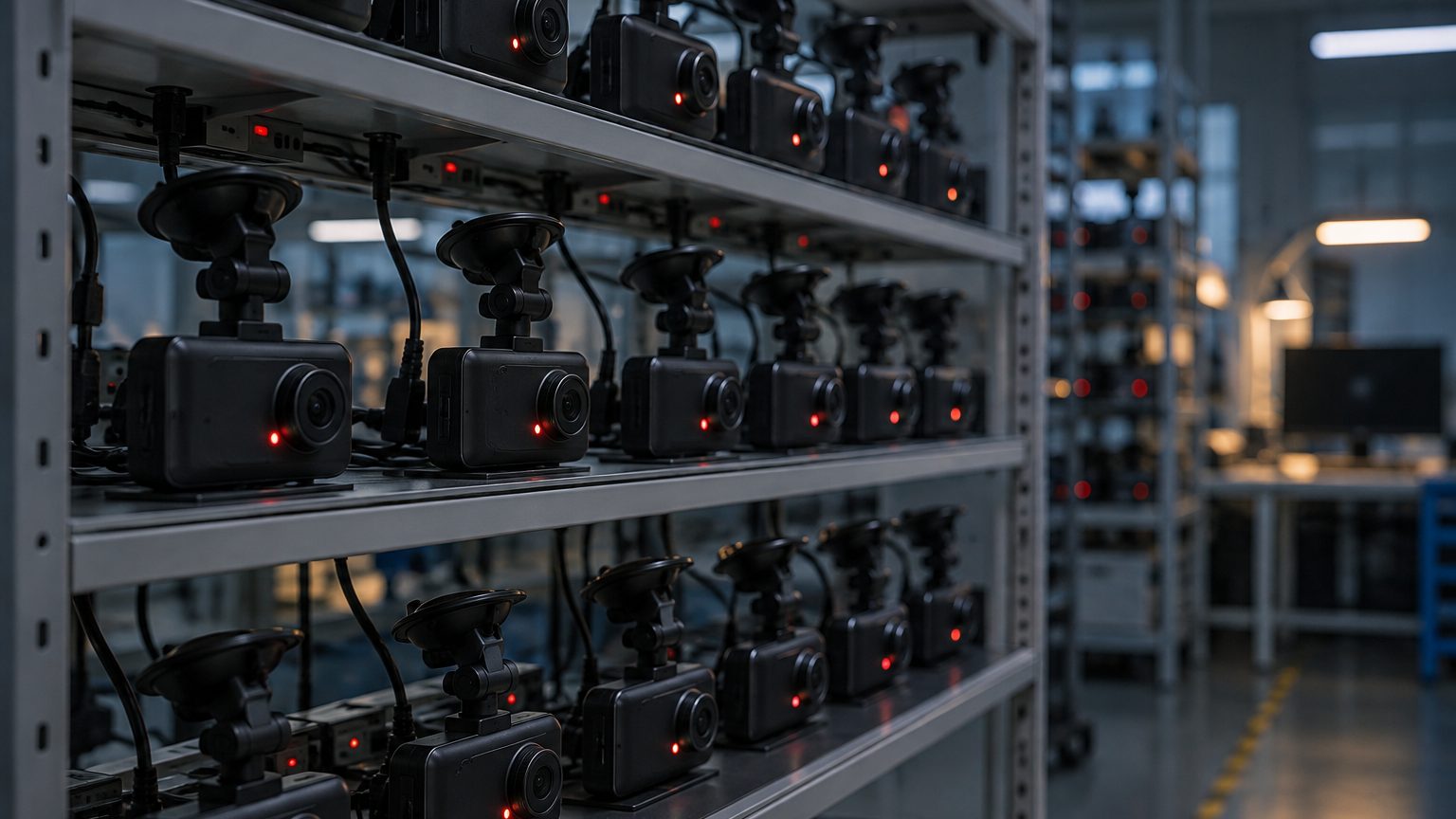
The lens module is the part that decides whether footage is sharp, and it is assembled and adjusted by hand or semi-automatically. After the lens sits on the sensor board, focus is set against a resolution chart and the lens is fixed in place. The next note in this series, lens focus calibration, covers that step in depth. Housing assembly follows: the board goes into the shell with its buttons, the supercapacitor or battery, the microSD slot and the mount. Material choice, fit and heat behavior are covered in the housing note.
Firmware, testing and run-in
Firmware is loaded by a flashing fixture, typically by cable or from a card, and the version is recorded. Every unit then goes through a functional test: it records a clip, locks a GPS position if it has GPS, pairs with a phone if it has WiFi, registers a tap on the G-sensor and responds to its buttons. The step is described in functional testing. After that, units run continuously for a program-specific period in the burn-in step, explained in burn-in and aging tests. Samples from a batch also go through high and low temperature checks according to the program. No durations or temperatures are fixed in this note because they differ by model and customer, and they are written into the program sheet.
Packing and the last inspection
Packing is its own station with its own errors. The wrong manual, a missing hardwire fuse tap or a card in the wrong box is a packing error rather than a product defect, yet the customer experiences it the same way. A packing list per carton and a count against the order catch most of it. Pre-shipment inspection then samples finished cartons under an AQL plan agreed for the order; see quality inspection. Packaging design is covered in the packaging note.
Where buyers should look closest
- Bill of materials versus the sample. The sensor, chipset and memory on the spec sheet should match what is inside.
- Focus pass criteria. Ask how the factory decides a lens passes, not whether it checks.
- Burn-in record. Ask for the duration and the number of units that failed during run-in.
- Firmware version control. The version on the sample, the version on the batch and the version in the app should agree.
- Packing against the order. Counts, accessories and language of the manual.
The full picture of how the desk follows these points is on the production process page, the equipment typically seen at partner factories is on factory equipment, and the checks are listed on quality control.
What changes between models
A single-channel 1080P unit and a 4K front-and-rear set follow the same route, but the second camera adds a lens module, a cable and a test: the rear camera has to be focused, connected and verified in its own recording channel. GPS models add an antenna check, WiFi models add a radio check, and rideshare units with an infrared cabin camera add an IR illumination check. More options mean more stations and more places where a batch can drift. That is one reason a simple, stable model is often the better first order for a new buyer. A custom program adds firmware and app work before the line starts; see firmware and app customization.
If you want to see a route for a specific model, send the brief through the quote form and the desk will return the stations, test list and sampling plan in writing.