
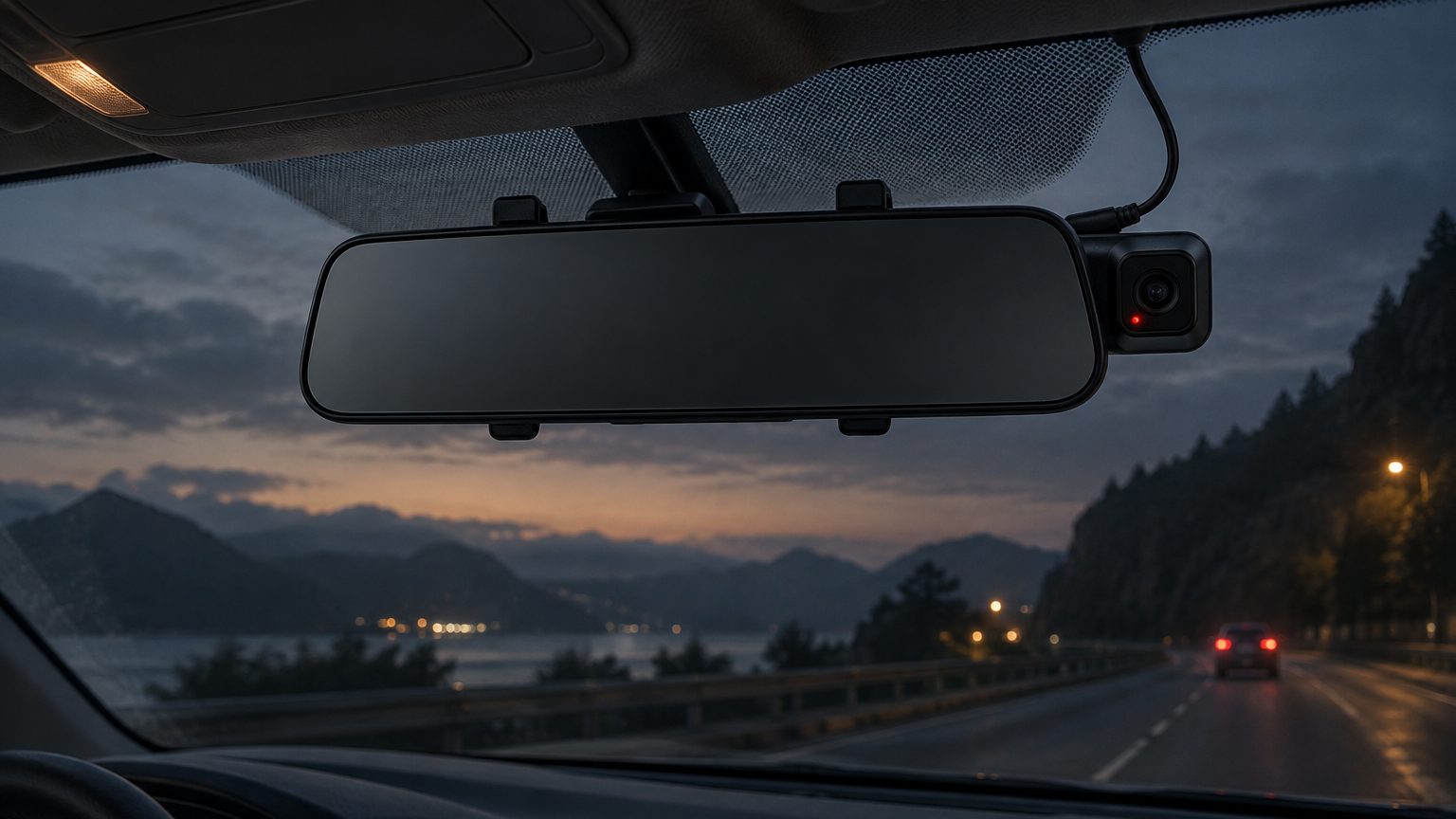
What a mirror dash cam is
A mirror dash cam is a recorder built into a rearview mirror body. Two styles dominate. The clip-on style straps over the car's existing mirror with elastic bands or brackets and is the quick, low-risk choice. The replacement style swaps the mirror on its original mount and is cleaner but more involved. Both usually carry a front camera on the back of the unit and a separate rear camera on a cable, with a wide display facing the driver. For an overview of how this form factor sits among the others, see mirror dash cams: pros, cons and buyers.
Why buyers choose the mirror form
The appeal is the display. A large screen turns the unit into a rear view monitor when reversing, with guide lines on many models, and it removes the need for a second device on the windshield. For drivers who dislike a camera hanging in their sight line, the mirror body is also the discreet option. The trade-off is sight: a clip-on unit can sit heavier on the mirror, and a screen that stays bright at night must be tuned so it does not distract. These are parameters to settle at sampling, not afterthoughts.
| Style | Install effort | Typical buyer | Watch point |
|---|---|---|---|
| Clip-on over mirror | Low; straps and one power cable | Online sellers, first-time buyers | Strap fit across mirror shapes |
| Full replacement | Higher; mount swap and wiring | Installers, dealer accessory programs | Fit to the vehicle mount |
| Streaming-media style | Medium; rear camera cable run | Rideshare and taxi drivers | Screen brightness at night |
The platform and the camera pair
Resolution on mirror units ranges from 1080P to 4K-class front recording, depending on the platform, and the rear camera is commonly a 2-megapixel sensor of the GalaxyCore GC2053 class at 1080P. The front sensor and chipset vary by model, so the sheet should name both rather than only a headline resolution. Frame rate in dual recording is worth asking for, since some platforms lower the front figure when both streams run. The mirror body also affects heat: a larger glass-and-plastic case with a bright screen runs warm, so a supercapacitor rather than a lithium battery is the sensible power buffer for hot markets.
Display and ergonomics
Because the screen is the product, small details decide reviews: brightness steps for night, an auto-dim option, a touch layer that works with gloves off or on, and a button layout that does not trigger by accident. Reversing guide lines should be adjustable to the vehicle width. Tuning these in firmware is a low-cost OEM item and often the difference between a unit that feels finished and one that feels generic.
Options and customization
Common options are GPS for speed and location stamps, a WiFi app for downloads, and a hardwire kit for parking coverage. Customization for private label covers your logo on the bezel and boot screen, your box and manual, and the guide-line style on the rear view. Beyond that, an OEM program can change firmware menus, app branding or the strap and bracket design. Shenzhen OEM suppliers commonly publish minimums from about 100 pieces per model for logo and packaging, with deeper changes quoted per project. See OEM and ODM.
Who buys this line
Online sellers use the clip-on mirror as a gift-friendly, visual product with a clear listing story: one screen, front and rear, no windshield clutter. Installer shops and dealers use the replacement style for an integrated look. Rideshare and taxi drivers like the large screen for reversing. Fleets rarely choose it as the primary camera, since a fixed windshield unit with GPS is easier to standardize; for that, look at GPS dash cams.
Certification notes
General information only; confirm with a compliance adviser or lab. A non-WiFi mirror unit follows the usual route: FCC Part 15 declaration in the US, CE with EMC, low-voltage safety and RoHS in Europe. A WiFi model needs an FCC ID and falls under the Radio Equipment Directive. Because a mirror unit sits in a driver's view, some markets look at mounting position, so confirm local rules before you list. Certificates come from the producing factory or lab and are verified by report number.
Buyer checks before ordering
- Fit check. Strap or bracket fit across the mirror shapes of your target vehicles.
- Screen check. Day readability, night brightness range and touch response with cold hands.
- Rear camera check. Focus after burn-in, cable length by vehicle, waterproofing of the connector.
- Packing check. Straps, cables and manual language against the spec sheet.
Reference lead times and minimums are set out on MOQ and lead time, and confirmed in writing for each program via the quote form.