
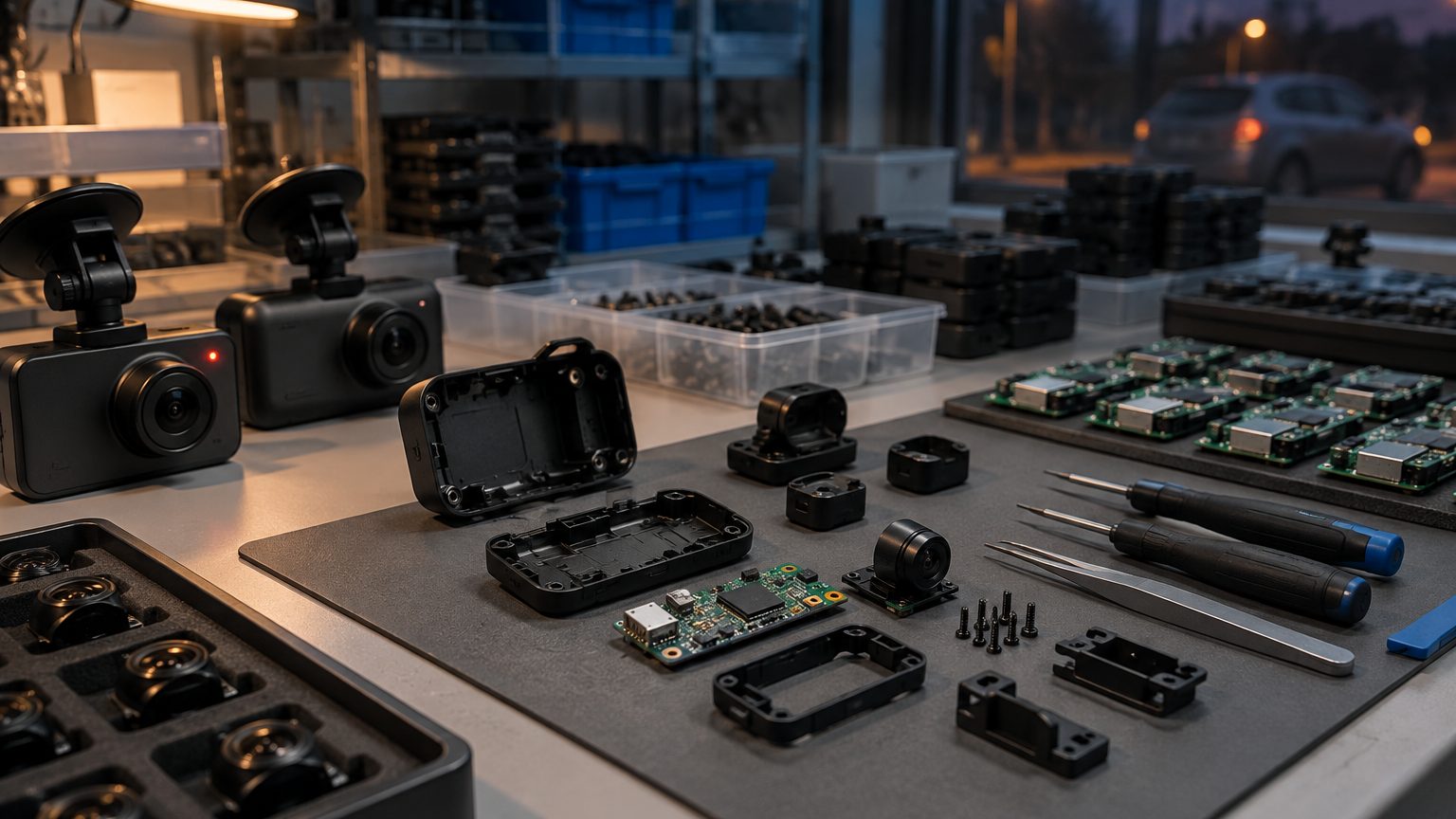
The flow at a glance
Every partner factory arranges its floor differently, but the order of work is the same because the physics is the same. Boards are built first, then tested, then married to the lens and housing, loaded with firmware, run for a while and finally tested again before packing. The stages below are the ones the desk reviews in a sample and again in bulk. Roadtrace coordinates and checks; the work itself is done by partner factories in Shenzhen.
- SMT. Solder paste is printed, components are placed by a pick-and-place machine, the board passes through a reflow oven, and automated optical inspection checks the result.
- PCBA test. The populated board is powered and checked for shorts, voltage rails and basic boot before it is allowed into assembly.
- Lens focus calibration. The lens module is aligned in front of a resolution chart, focused and fixed. This step decides how sharp the image is from the first frame.
- Housing assembly. Board, lens, screen, buttons and supercapacitor go into the housing, with cables and mounts attached.
- Firmware flash. The agreed firmware build is loaded and the version is recorded against the batch.
- Burn-in. Units record continuously for a period set per program, which exposes weak cards, heat sensitivity and unstable firmware.
- Functional test. A fixture or checklist verifies recording, GPS lock, WiFi pairing, the G-sensor, buttons and screen.
- Packing. Units, accessories, manual and card, if bundled, go into the gift box, then the master carton with agreed marks.
Why the order matters
The sequence is built to catch faults as early and as cheaply as possible. A bad solder joint found at AOI costs a rework; the same fault found after burn-in costs a whole unit and a day. Focus calibration sits before final assembly because it is far easier to adjust a loose module than a sealed unit. Firmware flashing sits before burn-in so that the build under test is the build that ships. A factory that moves these stages around, for example by flashing after packing, is a factory the desk questions.
What is checked at each stage
| Stage | Typical check | Evidence the desk can request |
|---|---|---|
| SMT and AOI | Placement, solder joints, polarity | AOI defect and rework record |
| PCBA test | Power, boot, interface continuity | Board test log |
| Focus calibration | Resolution chart at agreed distance | Calibration record per batch |
| Assembly | Fit, seal, screws, cable routing | Line inspection checklist |
| Firmware flash | Version, language, boot screen | Firmware version record |
| Burn-in | Continuous recording without drop-outs | Burn-in log, duration per program |
| Functional test | Record, GPS, WiFi, G-sensor, buttons | Test sheet or fixture output |
| Packing | Contents, labels, carton marks | Packing list and carton photos |
Burn-in and temperature
Burn-in is the stage buyers most often ask about. The unit runs continuously on recording, usually in a rack with the cards that will ship, so that errors with sustained writes become visible. Its length is set per program and recorded; the desk does not quote a figure the factory has not documented. High and low temperature checks are run on a sampling basis per program, because a windshield in summer is the harshest place the product will work. The equipment behind these steps is on factory equipment.
Records worth asking for
Because every stage can leave a record, a buyer can ask for a surprisingly complete picture of a batch without visiting the floor. The most useful items are the firmware version stamped to the batch, the burn-in log with the count of units that failed and why, the functional test sheet, and the packing list with carton photos. Together they show that the unit you receive is the unit you approved, and they make any later discussion about a defect a matter of evidence. The desk asks for these records on every program and keeps them with the golden sample.
Where programs differ
A ready model follows the factory's standing routine, so the main variables are packing and labeling. Private label adds logo printing or laser marking and custom packaging. ODM programs add a mold and a longer sampling loop before any of the eight stages run at volume. Each route and its reference minimums are described on OEM and ODM and MOQ and lead time.
What the desk reviews before shipment
The desk compares the sample, the golden sample and a random pull from bulk against the spec sheet, then reviews the stage records the factory supplies. Findings, deviations and fixes are written down before the cartons are sealed. The inspection plan and sampling method are on quality control. To scope your own program, use the quote form.