
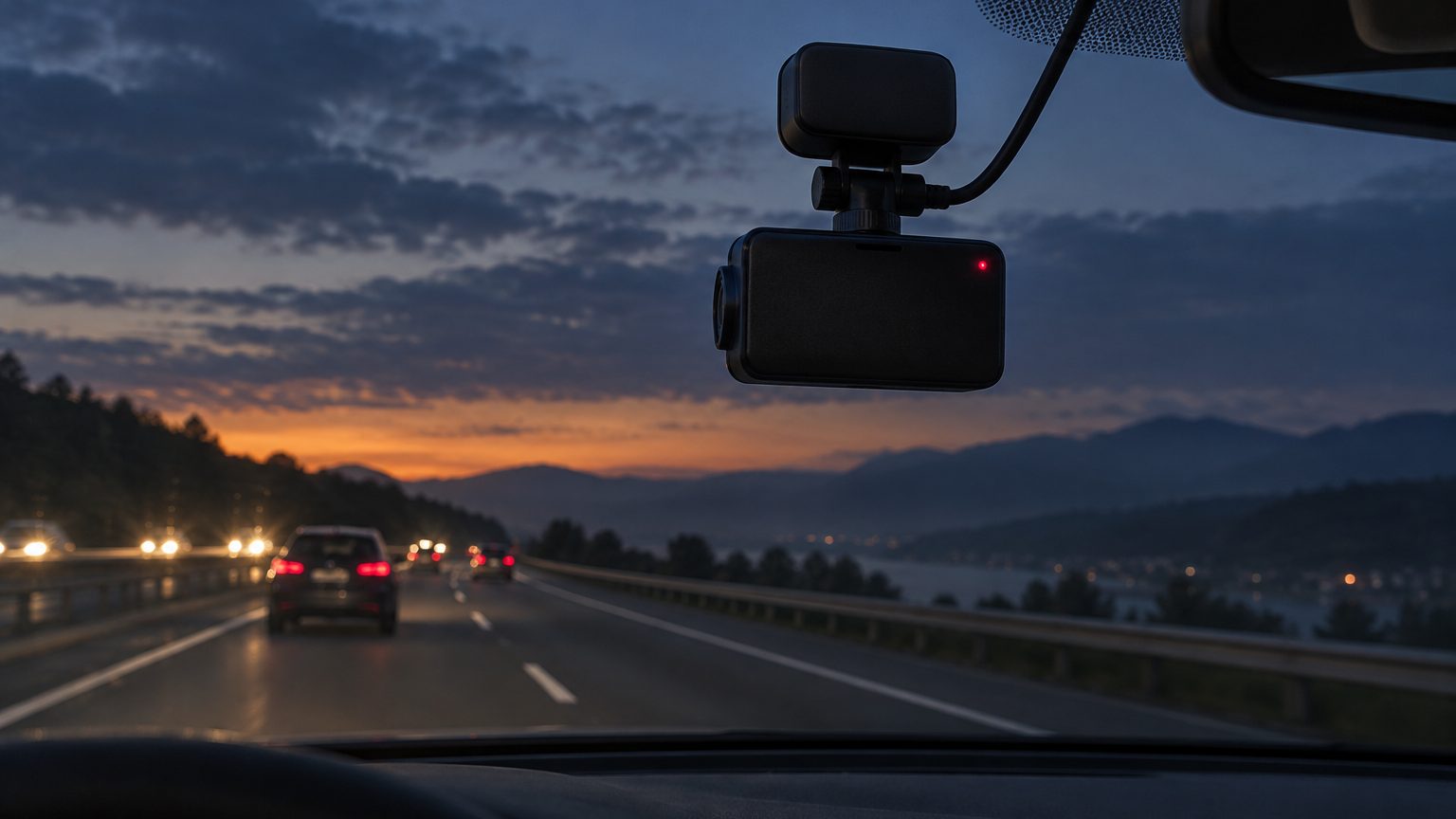
What GPS adds to a dash cam
A GPS module reads satellite signals and writes position, speed and time into each recording. Played back on a PC viewer or phone app, the clip carries a map of where the vehicle was and how fast it was moving. That turns a dispute over what happened into a record with a time and a place, which is why insurers, rental operators and fleets ask for it. The general case is set out in GPS in dash cams. For a single private buyer, the same feature mostly adds a speed stamp and a travel log.
Built-in or external GPS
GPS reaches a dash cam in two forms. A built-in receiver is compact and cheaper to ship, but it must see the sky through a windshield that may carry a metallic tint. An external antenna sits on the dashboard or in the mount and gets a cleaner signal, at the cost of one more cable. Both are common, and the choice depends on the vehicles. Tinted glass, heated windshields and metal-coated films can slow the first fix, so the desk tests acquisition time on a representative windshield during sampling.
| Variant | Strength | Watch point | Typical buyer |
|---|---|---|---|
| Built-in GPS | Compact, one cable | Signal through tinted glass | Online sellers, retail |
| External GPS antenna | Stronger signal, flexible placement | Extra cable and mount | Fleets, installers |
| GPS plus rear camera | Route plus rear evidence | Cable run for long vehicles | Trucking, delivery |
| GPS plus cabin camera | Route plus driver evidence | Privacy and consent policy | Rideshare, taxi, rental |
Platform and data
GPS appears on the same chipset families as other lines: Novatek NT96670-class for 4K, and lower-cost platforms for 1080P. The sheet should state the stamp format (speed unit, date format), whether the stamp is burned into the video or stored in a separate log, and whether the PC viewer is branded and available for the systems your customers use. For a fleet buyer, the playback software is part of the product, and a program is more reliable when the viewer runs on the customer's standard computers. Details are on the technology page.
Who buys it and for what
Fleet operators and telematics integrators use GPS dash cams to match footage to routes and reduce disputes. Trucking companies add a rear camera and use the log for compliance paperwork. Insurance and insurtech programs value time-and-place evidence on a claim. Car rental and subscription operators use it to answer damage claims between handovers. Online sellers use it to widen a range with a model that suits fleet-minded private buyers. See the buyer pages for fleet dash cam solutions and insurance and telematics.
How programs are usually specified
A fleet or insurer brief tends to settle five items before sampling: whether GPS is built in or external, whether the stamp is burned into the picture, which viewer software the customer runs, whether a rear or cabin camera is added, and how data is retained and shared. A smaller online seller usually settles two: built-in GPS and a bundled card. Writing these into the spec sheet early stops the common mismatch where an installer expects an external antenna and the box ships with a built-in module.
Customization
For fleet and insurer programs, customization usually centers on the viewer software, the stamp format and default settings pushed in firmware, in addition to the logo and box. Branding the PC viewer or the app is an OEM item and is quoted per project. Logo and packaging customization commonly start from about 100 pieces per model at Shenzhen OEM suppliers; deeper firmware and software changes carry higher minimums confirmed per program. See OEM and ODM.
Certification notes
General information only; confirm with a compliance adviser or lab. A GPS receiver is a receive-only radio and is normally covered by the standard EMC route; if the model also has WiFi, it needs an FCC ID and Radio Equipment Directive conformity. Commercial-vehicle and fleet programs often ask for an E-mark under UNECE R10 for vehicle electronic sub-assemblies. Reports come from the producing factory or lab and are verified by number. Privacy law on location data varies; the desk gives general information only.
Buyer checks before ordering
- Fix test. Cold-start time and fix retention on a representative windshield.
- Accuracy test. Compare speed stamps against a reference over a short drive.
- Viewer test. Install the viewer on your standard computers and play back a route.
- Stamp test. Date format, time zone handling and speed unit for your market.
Reference lead times and minimums are confirmed in writing for each program on MOQ and lead time. Start with the quote form.