
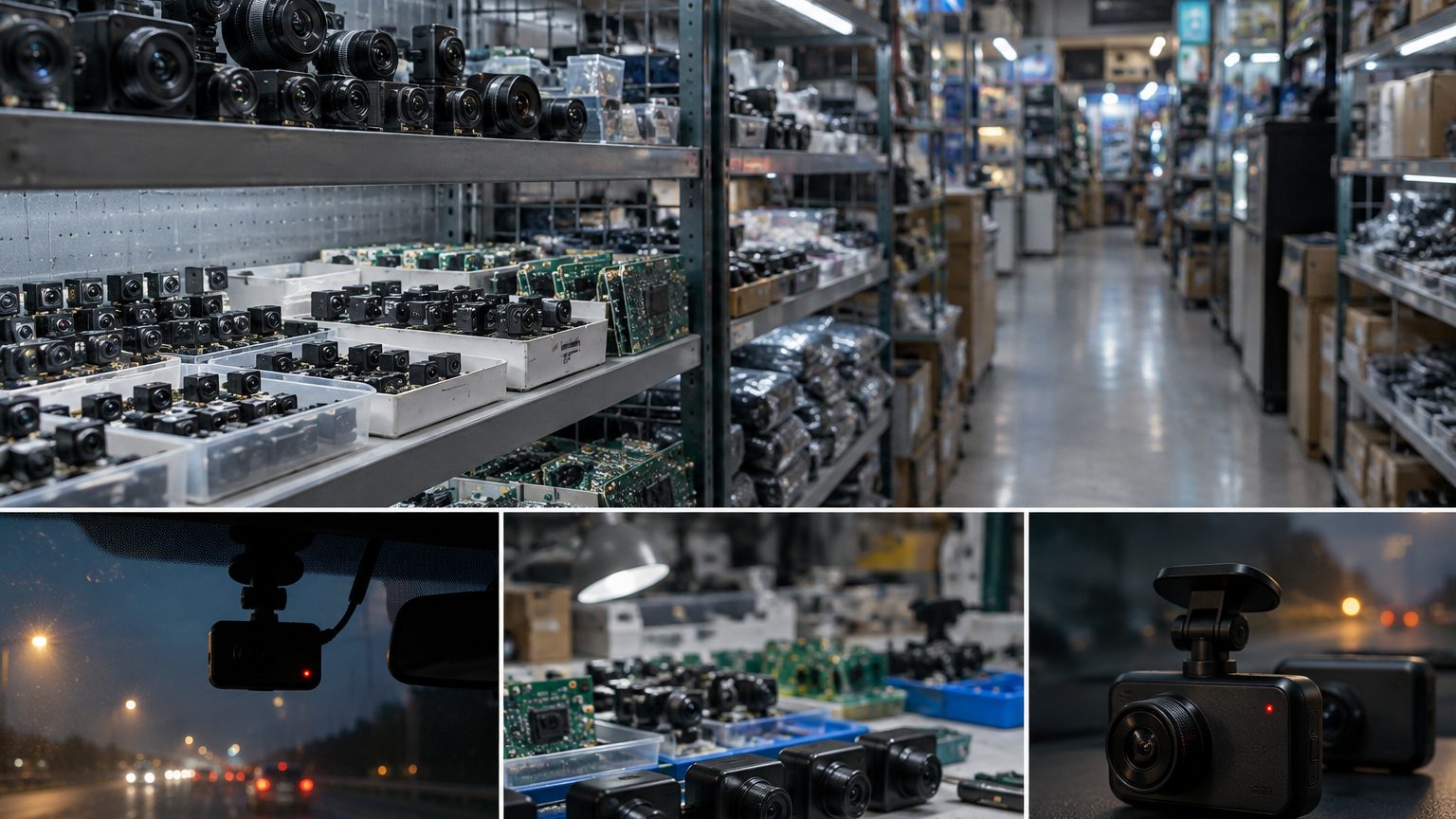
Why dash cams cluster in Shenzhen
Industry compilations list most Chinese dash cam makers as Shenzhen companies, and the main domestic brands are headquartered in the city. The reason is practical rather than mysterious. A dash cam is a small consumer-electronics product with a short list of specialist parts, and nearly all of those parts can be bought, tested and assembled within a short drive. Government and press reporting also describes the Bao'an and Longhua districts as large electronics bases, with smart devices and ultra-HD video display among the clusters named. Those are district-level statements, not dash cam figures, and the desk does not present them as such.
For a buyer, the benefit is speed and choice: a sample can be revised in days because the lens, board and housing suppliers are close, and several partner factories often build on the same recognizable platform. The cost is that quality varies widely inside the cluster, which is why screening matters more than location.
The layers of the supply chain
It helps to read the chain as layers, because each layer has its own failure modes and its own questions for a factory. The table lists them in build order.
| Layer | What it supplies | Question the desk asks |
|---|---|---|
| SoC solution houses | Chipset, reference firmware and tuning, for example Novatek NT96670-class platforms for 4K | Which platform, and who maintains the firmware? |
| Sensor and lens suppliers | Image sensors such as the Sony IMX415, and lens modules | Native sensor resolution, lens source, focus method |
| PCBA and SMT | Populated boards, supercapacitors, connectors | Which lines, and what inspection follows reflow? |
| Molds and housings | Plastic and metal parts, mounts, buttons | Existing tooling or a new mold? |
| Assembly | Final build, firmware flashing, functional test | Test fixtures and records kept per batch |
| Packaging | Gift boxes, manuals, cartons, labels | Artwork lead time and carton marks |
| Ports and freight | Yantian, Shekou, air via Bao'an or Hong Kong | Mode, Incoterm, documents |
SoC houses and component markets
The chipset decides most of what a dash cam can do, so the first layer to understand is the solution house that supplies it. In the cluster, 4K models are commonly built on Novatek NT96670-class chipsets, some 1440P models on NT96675-class parts, and a smaller number on Rockchip RK1126 or Ambarella platforms. These are component facts, not endorsements: each platform has trade-offs in image processing, heat and firmware support. Passive parts, connectors and many small components are sourced through the Huaqiangbei electronics market, which is a large part of why replacement parts for a revised sample are rarely a long wait. The technology page explains how to read these lines on a spec sheet.
Sensors, lenses and the image
Image quality is set by the sensor, the lens and the tuning, in that order of importance. Sony STARVIS-series sensors and GalaxyCore parts, such as the 2-megapixel GC2053 used on many rear cameras, are sold through distributors in the cluster. The lens module is a separate supplier, and its focus calibration at the factory is what separates a sharp batch from a soft one. The desk asks where the lens module comes from and how focus is set; the production process page shows where that step sits in the build.
Boards, housings and assembly
PCBA is done on SMT lines, either at the partner factory or at a subcontracted board house that the factory names. Housings come from existing molds or, in ODM programs, a new mold. Final assembly, firmware flashing and functional testing then happen at the partner factory. Where a step is subcontracted, the desk records that in the factory profile, because the buyer deserves to know which steps happen where. Equipment at the factories is covered on factory equipment.
How partner factories are screened
A factory enters a program only after a short, consistent screening. The desk checks the following, and records the answers in the factory profile.
- Platform fit. Does the factory already build the chipset and sensor combination in the spec sheet, with firmware it can maintain?
- Documents. Business registration, test reports and certificates relevant to your markets, verified by report number rather than by a file name.
- Sample quality. Day and night footage, function checks and a note on every deviation from the spec sheet.
- Process records. Whether burn-in, focus calibration and functional test are run and recorded per batch.
- Communication. Written answers to technical questions, and a named contact for changes.
- Audit option. A visit or third-party audit can be arranged for confirmed programs before bulk production.
What this means for your program
Because the supply chain is local, a custom change such as a revised boot screen, a different cable length or a new box is a matter of days rather than months, but only if the partner factory is organized to take it. Screening is how the desk reduces the chance of a surprise. Reference MOQ and timing for each route are on MOQ and lead time, and the quote form is the place to start a shortlist.