
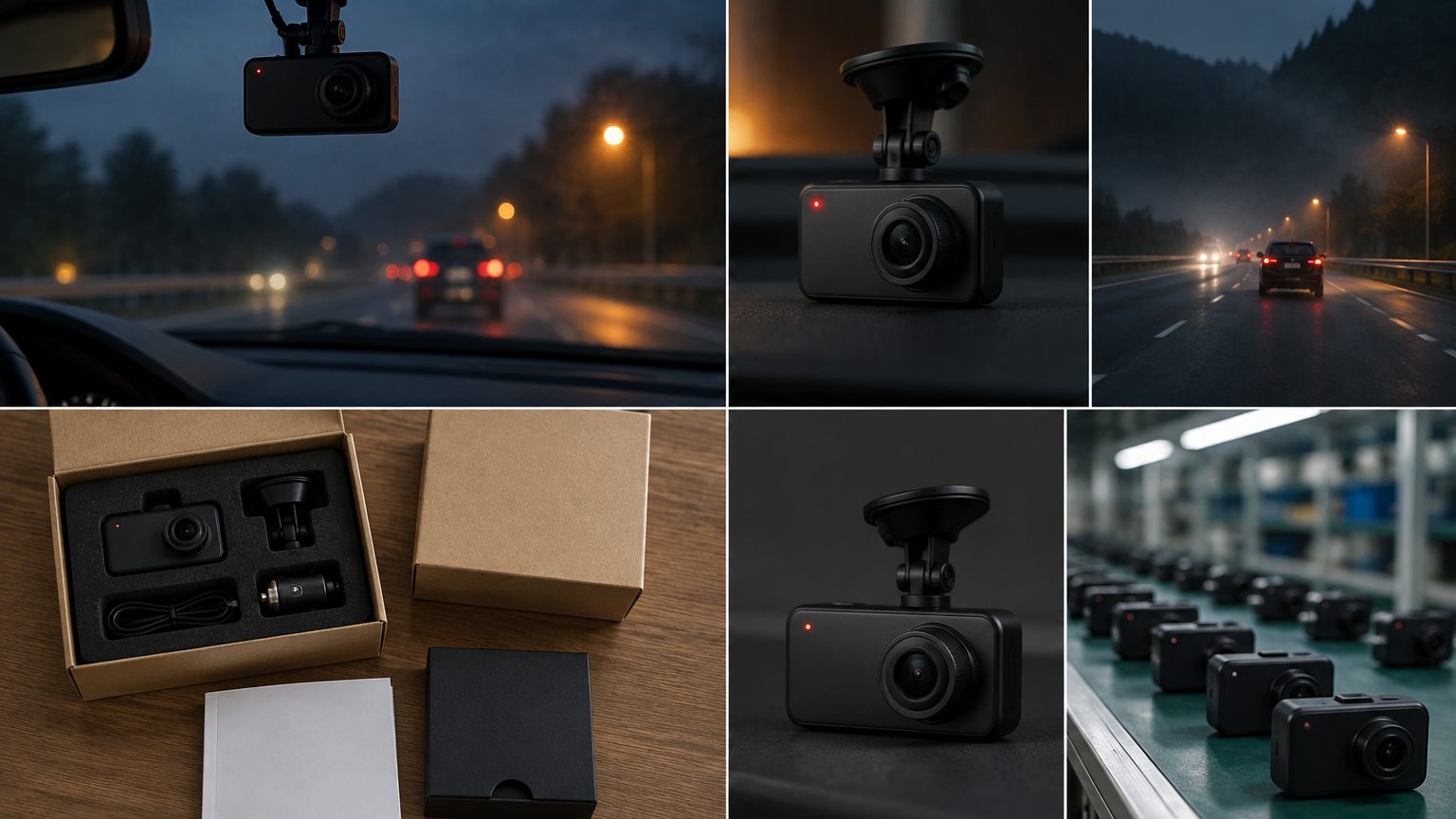
What private label covers
In a private label program the camera platform stays the partner factory's proven design, while the identity layer is yours. That layer has five parts: the logo on the housing, the retail box, the printed manual, the inserts and the labels. Shenzhen OEM suppliers commonly publish minimums from about 100 pieces per model for this work, which is why it suits sellers testing a range. Anything that changes the electronics or the housing shape moves into OEM and ODM, and anything in the firmware is on the firmware page.
Logo on the housing
Logos are applied by pad printing, laser engraving or silk screen, depending on the housing material and finish. Pad printing and silk screen suit most plastic housings; laser engraving suits darker finishes and holds up to cleaning. The desk asks for vector artwork, the logo's maximum size and a position on the housing drawing. A sample photo of the actual print is part of sampling, because a logo that looks fine on a screen can read too small on a compact body.
Gift box, manual and inserts
| Element | Typical options | What to prepare |
|---|---|---|
| Retail box | Folding carton, rigid gift box, window box | Artwork on the factory dieline, finish choice |
| Manual | Folded sheet or booklet, one or several languages | Text in each language, reviewed by a native speaker |
| Quick-start card | Single card with app and card-format steps | QR link to your support page |
| Warranty card | Printed card with your support contact | Terms agreed with your own advisers |
| Inserts | Cable clips, trim tool, adhesive pad, SD card | Bill of materials in the spec sheet |
| Master carton | Export carton with carton marks | Marks, quantities per carton, language |
Manuals, regulatory marks and text
The printed manual and box text carry claims, so they should match the unit in the box. If the box says 4K, the sensor should support it; if it says WiFi, the app and certification should be in place for the market. Regulatory marks such as CE or the FCC identifier belong on the product label only where the report supports them. Certificates and test reports come from the producing factory or lab and are verified by report number, as described on certifications. For the 4K claim, see the sensor discussion in true 4K versus upscaled 4K.
Barcodes and marketplace preparation
Online sellers usually need a barcode on each retail box and, for some warehouses, a second unit label on request. The desk can arrange marketplace warehouse labeling at the factory so cartons arrive ready to check in, instead of being relabeled on arrival. Provide the barcode files, the label size and the carton marking you need. A mixed carton of different models is a common cause of receiving problems, so cartons are kept single-model unless the program says otherwise. The post on marketplace-ready dash cams covers the checklist.
Choosing what to brand first
Not every program needs every element on day one. A common sequence is to start with the logo and a simple branded box, learn what customers ask, and add a branded app, a richer insert set or a bundle with a card and hardwire kit in the second order. This keeps the first minimum low and lets real feedback guide the packaging spend. The exception is a program with a retail partner or a fleet contract, where the full identity is part of the agreement and should be fixed from the start. In both cases, keep a single master of artwork files, so a reorder uses exactly the approved version.
Proofs, samples and sign-off
- Artwork brief. Logo files, box text, languages, barcode data.
- Dieline proof. Digital proof of the box and manual on the factory template.
- Printed sample. One finished box with a branded unit, photographed and shipped if needed.
- Golden sample sign-off. The approved sample is the reference for bulk packing checks.
Packaging and bundles interact: a hardwire kit or a 64GB card in the box changes the insert list and the box size. Plan them together, then send the brief with the quote form.