
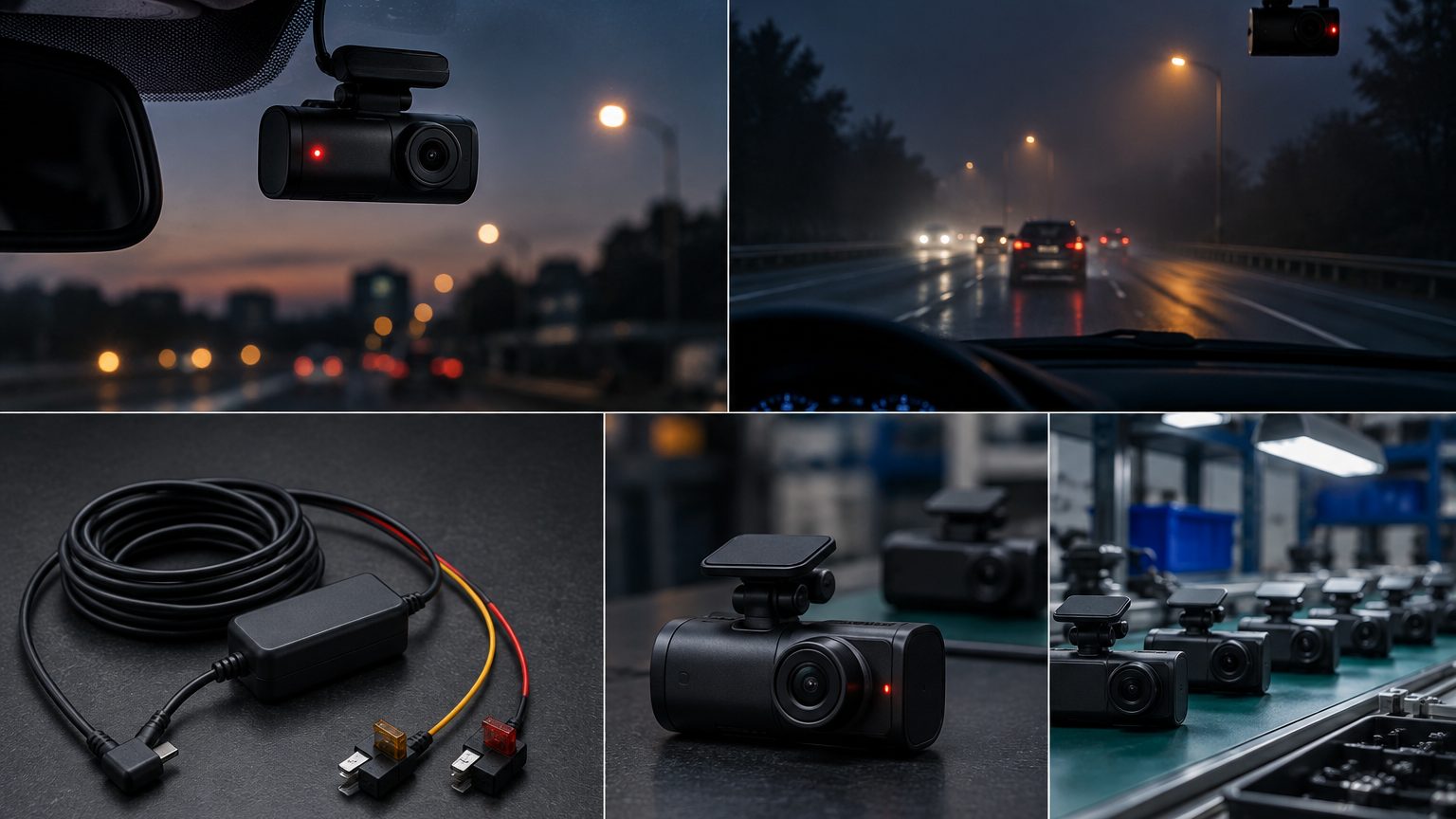
What a hardwire kit does
Plugging a dash cam into the cigarette lighter works, but it leaves a visible cable, occupies the socket and powers off with the ignition on many cars. A hardwire kit solves all three. It connects to the vehicle's fuse box with fuse taps, converts the 12V or 24V supply to the 5V a dash cam expects, and feeds the camera through a thin cable routed along the trim. The camera sees power even when the engine is off, which is what makes parking mode possible, and the kit watches the battery so recording stops before the car cannot start.
For sellers, that is why the kit pairs naturally with a camera: it turns a single product into a complete install, and it fixes the most common cause of poor parking-mode reviews. Parking logic is explained in parking mode explained.
How the kit works
A typical kit has three parts: a power lead with fuse taps and a ground eyelet, a small step-down module with the low-voltage cutoff, and a cable ending in a Type-C or mini USB plug, depending on the camera. The module watches the voltage and shuts the output when it falls below a set threshold. Some kits let the buyer pick the threshold with a switch or small dial; others fix it at a value chosen with the camera maker. Kits for trucks and vans take 24V input, which is why the input range on the spec sheet matters more than the plug.
| Item | Options | What to confirm |
|---|---|---|
| Input | 12V cars, 12/24V wide range for trucks | Stated input range, in writing |
| Output | 5V to the camera | Output stability under recording load |
| Cutoff | Fixed or selectable thresholds | Value and restart behavior |
| Plug | Type-C, mini USB, right-angle or straight | Match to the camera model, tested |
| Fuse taps | Mini, low-profile or standard styles | Styles used by your target vehicles |
| Cable | Length varies by vehicle | Length for sedans versus vans and trucks |
Bundles and variants
- Kit alone. For installers and shops that already stock cameras.
- Camera + kit bundle. A matched pair with the plug tested for fit; the strongest basket-builder for online sellers.
- Camera + kit + card. Adds a 64GB or 128GB high-endurance card; see SD cards.
- Dual-camera bundle. A kit with a split output or a longer cable for a front-and-rear camera pair.
Audience and scenario
Installers and car-audio shops buy the kit alone in volume because it is part of nearly every job. Online sellers buy bundles because customers search for "dash cam with hardwire kit". Fleet and rental operators ask for it on every vehicle so that cameras record during idle periods and cables stay out of the way. Trucking companies need the 24V version and often a longer cable run. Programs for these groups appear on the distributors and installers page.
Customization
Logo on the packaging, a branded install card, cable length, plug type and tap style are the usual changes. Kits can be re-labeled with your model name, and colors of the module housing can follow your range. Firmware does not apply to the kit itself, but a bundle needs the camera's firmware set up to expect the kit: parking-mode settings, buffer time and voltage cutoff are checked together at sampling. Shenzhen OEM suppliers commonly publish minimums from about 100 pieces per model for logo and packaging, confirmed in writing per program.
Certification notes
The kit is a vehicle electronic sub-assembly. For commercial-vehicle and fleet programs, E-mark (UNECE R10) documents are often requested; consumer sales typically need CE (EMC and LVD) and RoHS in the EU and Supplier's Declaration of Conformity in the US. Details are on certifications. Reports come from the producing factory or lab and are verified by report number.
Buyer checks before ordering
- Bench test. Power the camera on the bundle, drop the input voltage and watch where the cutoff acts.
- Fit test. Check taps against fuse styles on two or three target vehicles.
- Plug test. Confirm Type-C or mini USB seating and cable strain relief.
- Parking test. Run a night in parking mode and review the battery state.
One more point for sellers: returns on kits rarely come from the electronics. They come from the wrong plug, a cable that is too short, or a customer who cannot find the right fuse. A clear install card in the box, a plug-type label on the outer carton and a short list of compatible vehicle types in the listing cut most of those cases before they start.
Reference lead times for kits are typically close to those of stock cameras, confirmed per program on MOQ and lead time. Send your list through the quote form.