
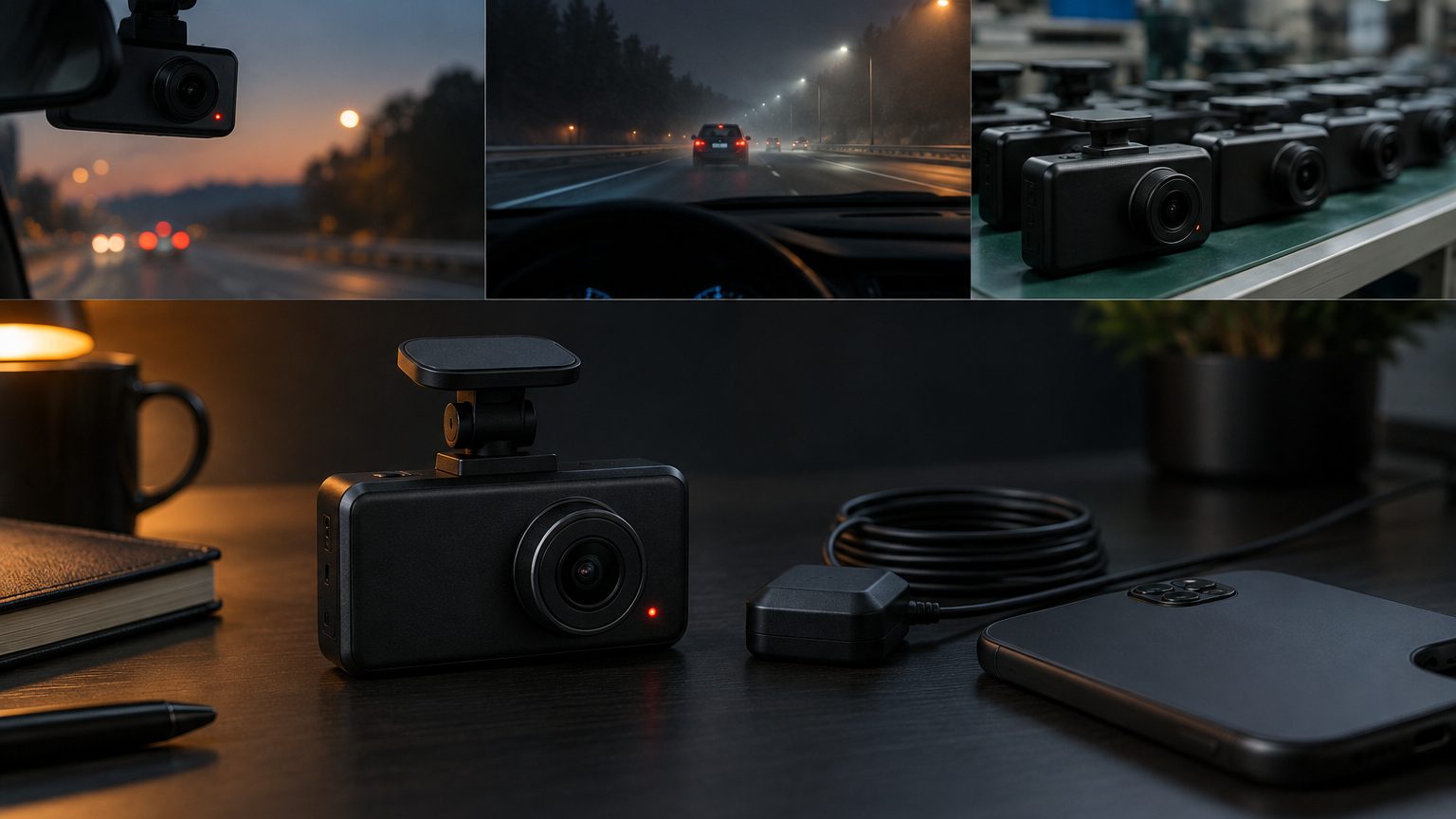
The short answer
ADAS stands for advanced driver assistance systems. In a dash cam the term means a set of software alerts that run on the same chipset that handles recording. The camera looks at lane markings and vehicles ahead and plays a tone or voice prompt when it sees a pattern. The common alerts are lane departure warning, forward collision warning, and a start-off or "front car has moved" reminder. These alerts are advisory. They do not brake, steer or control the vehicle, and they do not have the sensors of a factory system such as radar. For a buyer the honest description is "driver alert functions", not "driver assistance system".
The usual alert set
| Alert | What it detects | Main limit |
|---|---|---|
| Lane departure | Vehicle drifting over a painted lane line | Faded or missing lines, snow, glare |
| Forward collision | Shrinking gap to the vehicle ahead | Distance estimated from a single camera |
| Start-off reminder | Car ahead moves while you are stopped | Traffic lights and busy junctions |
| Driver fatigue (cabin models) | Eye or head patterns from a cabin camera | Lighting, glasses, camera angle |
| Speed camera prompts | Stored location list | Rules differ by country; list must be maintained |
Speed camera warnings deserve a separate note: some countries restrict devices that warn of enforcement locations, so a feature that is fine in one market can be a problem in another. This is general information; check local law and have the supplier switch the function off for restricted markets.
Why calibration decides whether it works
Vision-based alerts depend on the camera knowing where the horizon and the vehicle hood sit in the picture. Most dash cams ask the user to set this on install with a short on-screen or app guide. If the camera is tilted, mounted off-center or moved to another car without recalibration, lane alerts fire late or constantly, and the owner decides the feature is broken. The practical effect for sellers is a rise in support questions. A good manual includes a diagram and a simple calibration step. Placement advice is in the windshield placement note.
What ADAS costs in complexity
- Chipset: the vision algorithms run on the main chip, so the feature may need more processing than a plain recorder. Some chipsets have the capability built in; others do not. Ask the supplier which chipset runs the model. The chipsets note gives the background.
- Firmware: the algorithms come as a licensed or in-house software package. Tuning false alarms is the biggest part of the work, and a bad tune sells poorly. See firmware quality.
- Sensor and lens: field of view and image quality affect lane detection. A very wide lens makes lane lines small and the distance estimate rougher.
- Quality control: a production line can confirm that the alert functions switch on and respond to a fixture, but road behavior is validated on samples, not on every unit. Ask what the factory validates per batch and what you validate at approval, so a tuning regression does not reach a container.
- Support: calibration questions and false-alarm complaints rise after launch. Plan a short FAQ and an on/off switch.
- Claims: overstated safety claims create returns and legal risk.
Certification and claims exposure
ADAS alerts do not add a radio, so the certification route follows the base model, WiFi or not. The exposure is in marketing language rather than in test reports. Describing alerts as a system that prevents collisions, or implying the camera brakes for the driver, invites product liability arguments and regulatory attention in markets that police driver-assistance claims. Keep the wording advisory: alerts, prompts, reminders. Some markets also have views on warning tones and on speed camera databases, mentioned above, which is why per-market firmware variants with the alert set adjusted are common in programs that ship to several regions. A compliance adviser should review listing copy for your main markets; this note is general information, not legal advice.
How to describe it honestly
Many listings use the words "AI" and "smart" for features that are simple rule-based alerts. Read the claims carefully and keep your own wording factual: which alerts exist, that they are advisory, that they need calibration, and that they depend on road markings and light. Do not suggest they prevent crashes or replace driver attention. The AI dash cams note separates real functions from marketing words, and the same discipline applies here. Alerts that are accurate in demonstrations on a clear highway may behave differently in rain, at dusk or in a city.
A useful exercise is to write the listing twice: once with the claims a supplier's own leaflet suggests, and once with only what a sample demonstrated on your test routes. The gap between the two versions is your returns risk. Keep the second version, add the calibration requirement and the conditions - daylight, visible lane markings, clear weather - and the description will survive contact with real customers.
Audience fit
ADAS alerts suit owners of older cars without factory systems, new drivers, and commercial buyers who want a basic nudge against drift on long routes. Trucking operators often prefer alerts together with recording and GPS. See trucking dash cams and dash cams for new drivers. Bus and passenger transport operators use alerts as part of a coaching program rather than as a safety device, pairing the prompts with footage review. Distributors in markets with many older vehicles find ADAS variants an easy mid-range step-up. For rideshare, alerts matter less than cabin coverage, and a simpler model often serves better. Buyers selling mainly on price, or into markets with strict rules, may be better with a clean recorder and no alerts at all; fewer features mean fewer complaints.
Specification checklist
- List the alerts in writing and mark each as default on or off.
- Confirm the chipset and where the algorithm comes from.
- Test on a real road in day and dusk conditions, not only in the supplier's clip.
- Ask for a mute switch and a per-alert on/off setting in the menu or app.
- Archive the firmware version and tuning file approved at sampling, and require written notice before any change.
- Prepare support answers for the two most common complaints: constant alerts and alerts that never fire.
Describe the markets and vehicle types in the quote form, and the written shortlist will mark which alerts are available per model.