
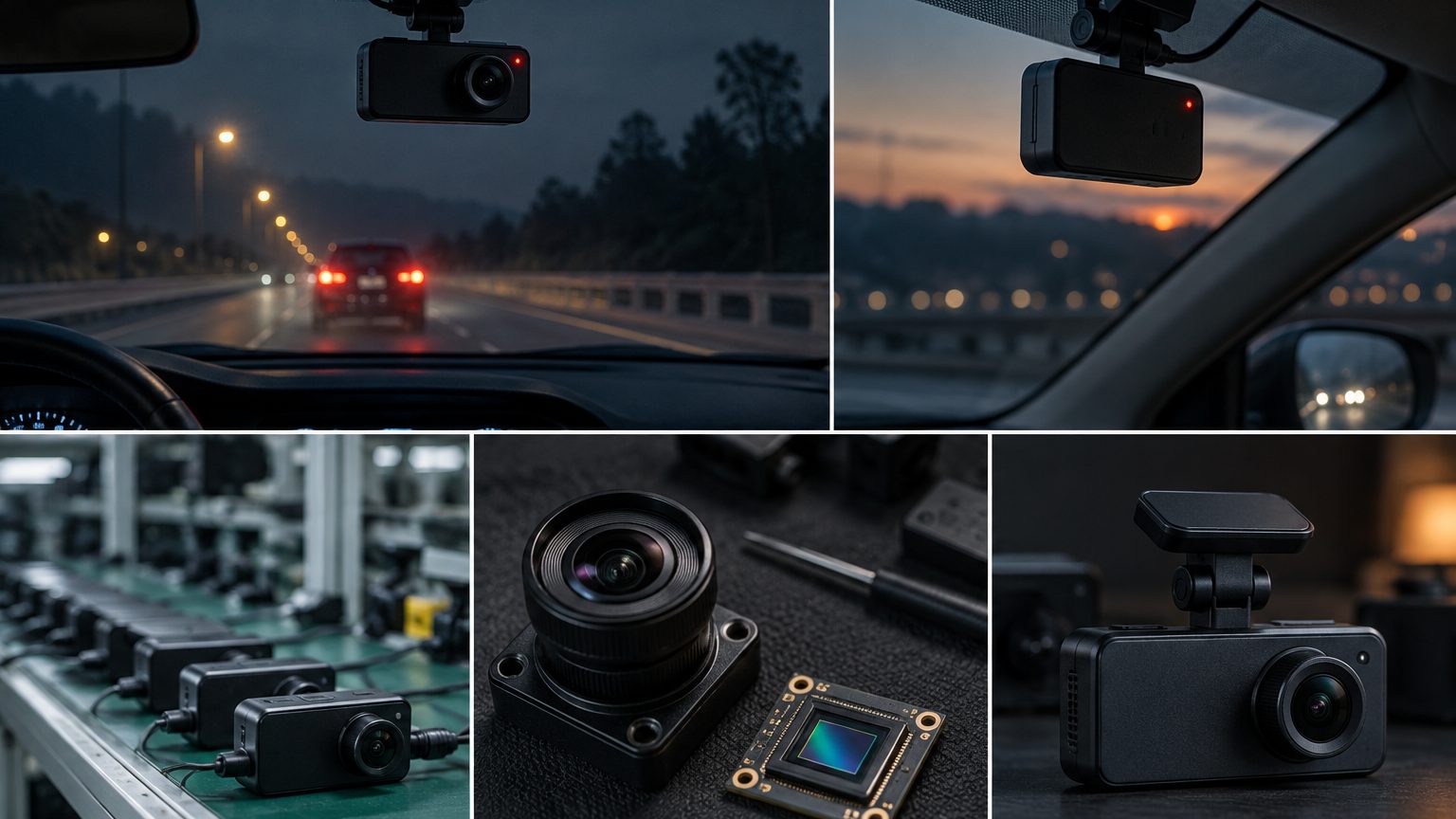
Why technology matters for a buyer
A dash cam's box lists resolution, field of view and a few feature icons. Three components decide the actual result: the image sensor, the chipset that processes it and the firmware on top. The remaining features - GPS, WiFi, 4G - decide the support load. The notes below translate each part into spec-sheet questions. Chip and sensor models are named here as component facts, not as endorsements, and the desk confirms the bill of materials in writing for each program.
Image sensors
The sensor sets the ceiling for detail and low-light performance. A Sony IMX415 is an 8-megapixel sensor that records native 3840 x 2160, which is what "true 4K" means. A Sony IMX335 is a 5-megapixel sensor that is often sold as "4K" through upscaling, and its native detail is lower. Newer premium models use STARVIS 2 sensors such as the IMX675 for better night performance, and rear cameras commonly use a 2-megapixel GalaxyCore GC2053 at 1080P. Read more in image sensors and true versus upscaled 4K.
Chipsets and codecs
The chipset records, encodes and runs the menu. A Novatek NT96670 is widely used in 4K models in the 2160P at 30 frames class; the NT96675 class appears in 1440P models; some 4K models use a Rockchip RK1126, and some premium models use Ambarella parts. The chipset limits frame rate in dual mode, the codec and the languages in the firmware pack. H.265 halves storage versus H.264 at similar quality, which matters for loop recording on a 64GB or 128GB card. See chipsets explained and H.265 versus H.264.
| Part | What it decides | Spec-sheet question |
|---|---|---|
| Image sensor | Native detail, low light | Which model, how many megapixels? |
| Chipset | Frame rate, codec, menu, app | Which platform, dual-mode frame rate? |
| Lens | Field of view, sharpness, flare | Glass or plastic, aperture, focus checked? |
| Power buffer | Heat tolerance, shipping | Supercapacitor or lithium battery? |
| Storage | Loop recording endurance | High-endurance card, speed class? |
Image processing: WDR and HDR
Wide dynamic range and HDR processing combine exposures so tunnel exits, headlights and bright skies do not wash out plates. They help at the edges of the scene but do not replace a good sensor, and results depend on tuning in firmware. Ask for sample clips from tunnels and night streets rather than reading the label. More in WDR and HDR, frame rate and bitrate, and field of view.
Power: supercapacitor and battery
A supercapacitor tolerates cabin heat better than a lithium battery and avoids lithium battery shipping restrictions; battery models raise heat and paperwork issues. Heat is a real design factor in parked cars, so power choice is one of the first spec decisions. See supercapacitor versus battery and heat resistance.
Connected features: GPS, WiFi, 4G, ADAS
- GPS stamps speed and position on footage; see GPS in dash cams and the GPS line.
- WiFi pairs the unit with a phone app for download without removing the card; see WiFi and app dash cams.
- 4G adds live view and cloud upload for fleets, with data plans and platform costs to plan; see 4G and cloud.
- ADAS alerts for lane departure and forward collision depend on processing and tuning, and vary widely; see ADAS alerts.
- Parking mode relies on a hardwire supply for buffered recording; see parking mode.
Lens, storage and the parts that fail first
Two components cause most field complaints and appear on few spec sheets. The first is the lens module: its focus is set on a calibration chart during assembly, and a unit that left the line slightly out of focus will record soft plates however good the sensor is. The second is the memory card. Loop recording rewrites the card constantly, so a high-endurance microSD card of 64GB or 128GB, with a suitable speed class, outlasts a general-purpose card. Both are covered in lens focus calibration and high-endurance cards, and the SD card line bundles them with cameras.
Putting it into a spec sheet
A useful spec sheet names the sensor model, the chipset class, the codec, the power buffer, the connected features and the certification target. Then it asks for sample clips by day, night and in a tunnel. The desk builds that sheet with you; start with the quote form, or compare lines on the products page.