
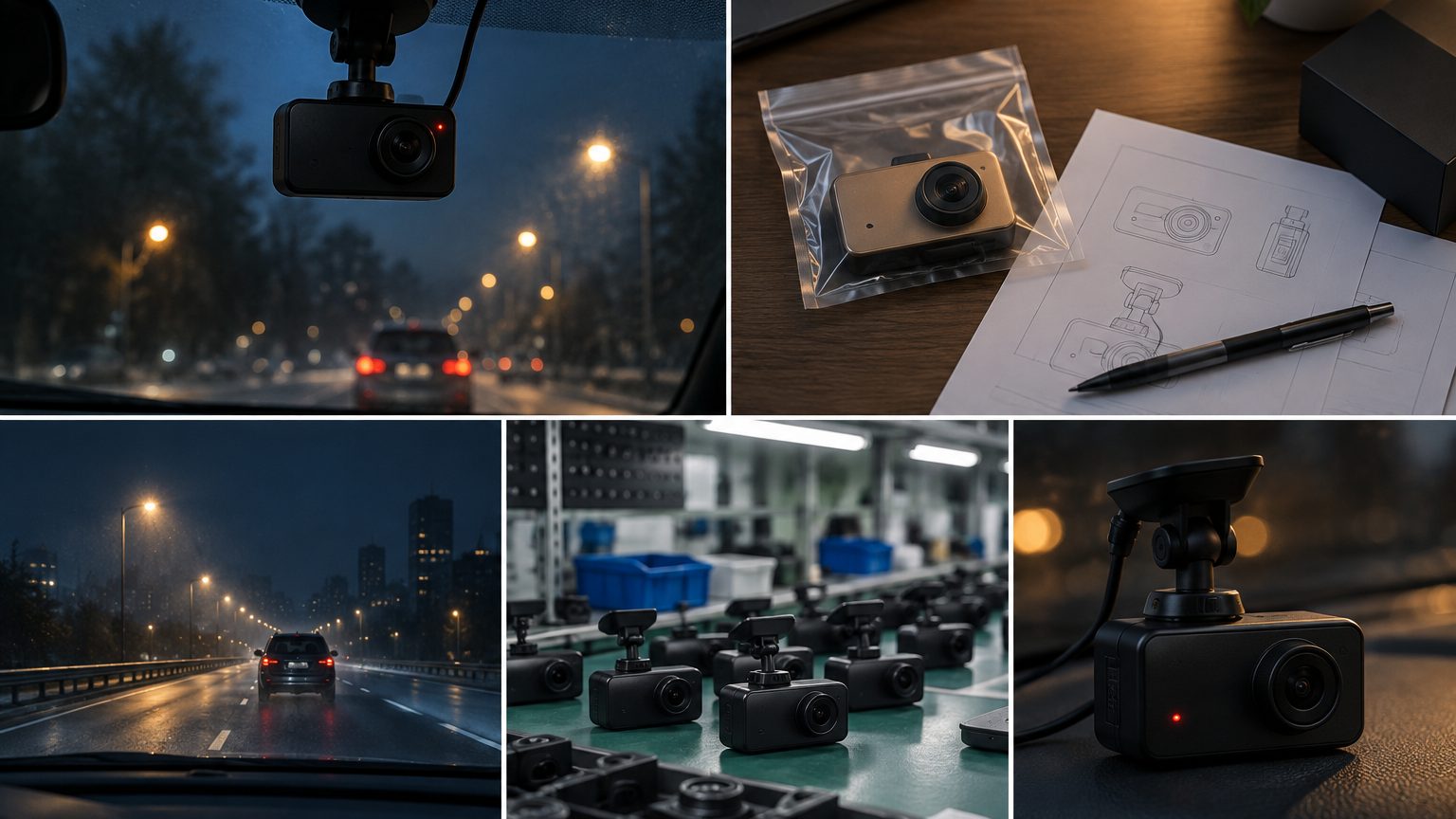
The ten steps at a glance
A dash cam program involves a chipset platform, a sensor, a housing, firmware, packaging, certification and freight. The process keeps these in one document and one sequence. Each step has an output, and no step is skipped for a repeat order; repeat orders are simply faster because earlier outputs are reused.
- Brief. Lines, quantities, markets, channels, branding depth and target date.
- Spec sheet. Chipset class, sensor, channels, features, accessories, packaging and certification targets written as one sheet.
- Shortlist. Partner factories that already build matching platforms, with reference MOQ and timing.
- Samples. Stock or custom samples reviewed against the spec sheet.
- Golden sample. One approved unit, with firmware version and packaging, kept as the reference.
- Purchase order. Quantities, specifications, packaging, terms and schedule confirmed in writing.
- Production. Bulk run on the approved build, with progress updates.
- Inspection. Pre-shipment checks against the golden sample.
- Shipping. Mode, term, documents and labeling per the logistics plan.
- After-sales. Defect handling, spare parts and repeat-order learning.
Brief and spec sheet
The brief is short; the spec sheet is where decisions are made. A good sheet names the sensor and the chipset class, not just "4K", because models sold as 4K can use either a native 8-megapixel Sony IMX415 or a 5-megapixel IMX335 that upscales. It lists features that the listing will promise - GPS, WiFi, parking mode, rear camera - and the accessories in the box. It also records the certification target by market. The technology overview helps with the vocabulary, and reading a spec sheet explains each line.
Samples and the golden sample
Samples are reviewed for day and night image quality, for every function the listing will mention, and for build and packaging. Stock samples ship in days; custom samples take about 7-15 working days. When a sample passes, one unit becomes the golden sample, recorded with its firmware version, and bulk is judged against it. Nothing in bulk is allowed to differ from the golden sample without a written change. The detailed test list is in the sample checklist.
| Step | Output | Who signs off |
|---|---|---|
| Spec sheet | One document with all specs | Buyer |
| Golden sample | Approved unit and firmware version | Buyer and desk |
| Purchase order | Written quantities, terms, schedule | Buyer and factory |
| Inspection | Report against the golden sample | Desk, or a third party if requested |
Production, inspection and shipping
Production follows the standard partner-factory flow: SMT assembly, lens focus calibration, housing assembly, firmware flashing, functional test, burn-in and packing. Pre-shipment inspection uses AQL sampling per program, with third-party inspection as an option. The desk checks images, functions, accessories, labels and carton marks before releasing the shipment. The details of the checks are on quality control, and the freight options on logistics.
What you do at each step
The buyer's part is smaller than the process suggests. You supply the brief and artwork, review the spec sheet and shortlist, judge the samples against your market, sign the golden sample and the purchase order, and arrange payment on the agreed terms. The desk and the partner factory handle the rest, reporting at each stage. Buyers who respond within a day at the sample and artwork steps usually save more time than any freight upgrade can recover later.
Documents you receive along the way
Buyers sometimes ask what they will actually hold at the end of the process. The set is short: the written brief and spec sheet, the shortlist with reference MOQ and timing, sample review notes with clips, the signed golden sample record with firmware version, the purchase order, production updates, the inspection report with photos, the shipping documents and, after delivery, a defect log. Together they form the audit trail for the program. When a marketplace question, an insurer's query or a customs check arrives months later, the answer is in the file, not in someone's memory.
After-sales and repeat orders
After delivery, problems come back through one channel. The desk collects the defect description, photos or footage, the batch and the golden sample reference, and handles it with the factory; whether the response is a replacement, a spare part or a credit is decided in the program terms agreed at the purchase order. Learnings go back into the spec sheet, so the second order is stronger than the first. The post on warranty and returns for resellers explains typical structures.
To start, send your brief with the quote form.