
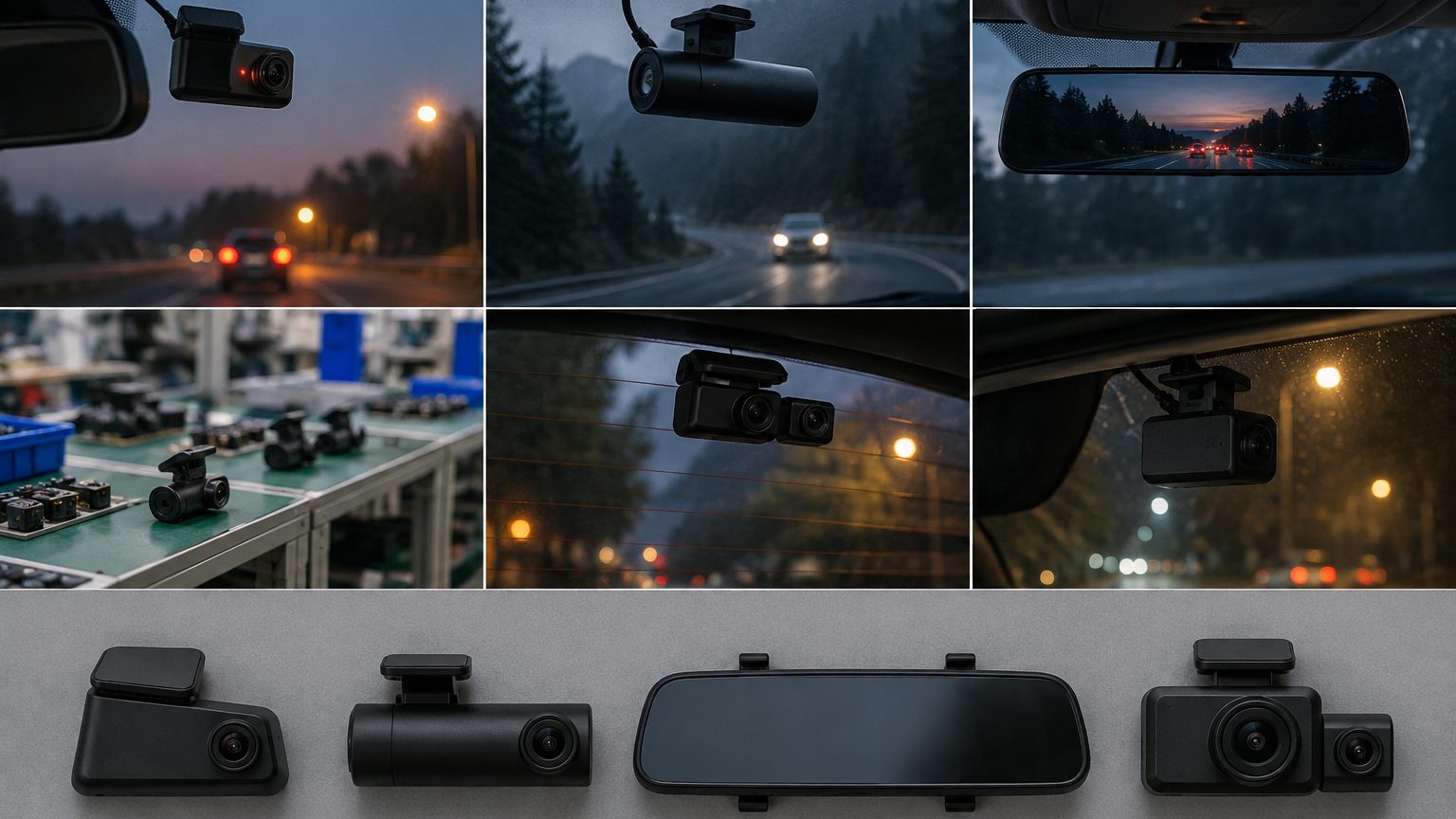
The short answer
A hidden dash cam is a compact recorder, often about the size of a small lighter or a thick cable tie, that attaches to the windshield behind the mirror so that it is barely visible from outside or inside. It usually has no screen. Settings and playback happen through a WiFi connection to a phone app, and a small indicator light or voice prompt confirms recording. Mini dash cams are similar but may keep a tiny display or a few buttons. The point of the format is discretion: it lowers the chance of theft of the camera and keeps the interior looking as the maker intended.
See the hidden and mini dash cam line for ready models, and the types guide for how the format compares with others.
Why buyers choose a hidden unit
- Appearance. Owners of premium or new cars often dislike a visible bracket and cable on otherwise clean glass.
- Theft deterrence. A device that cannot be seen from the street is less likely to attract a break-in.
- Fewer distractions. No screen means no glowing display at night and nothing to fiddle with while driving.
- Installer-friendly. Car-audio and detailing shops like a clean install they can sell as a premium service.
These buyers often add a hardwire kit, which hides the power cable along the trim and enables parking mode. Pair the unit with the hardwire kit to complete the discreet look - a hidden camera on a dangling 12V cable defeats its own purpose.
What you give up
| Benefit | Trade-off | What to do |
|---|---|---|
| No screen | Cannot review footage in the car | Make sure the app is stable and well localized |
| Small body | Less room for heat dissipation | Ask about the supercapacitor and operating temperature |
| Tiny lens module | Often smaller sensor or simpler lens | Request night and tunnel sample footage |
| Behind the mirror | Possible blocked angle or narrowed view | Check the mounting angle on real windshields |
| App control | Radio certification needed | Confirm FCC ID, CE/RED for the market |
The most common complaint in this family is app stability. A hidden dash cam is only as useful as the app that downloads the footage, so test the connection process with a few phones of different brands and ages before an order. Check the pairing steps, the download speed and whether the app keeps its settings between sessions. The WiFi and app dash cam note covers what to look for in detail.
Heat and storage in a small body
Small devices pack the chipset, memory and power system into a tight space on a sun-exposed windshield, which is the harshest environment in the car. A supercapacitor tolerates heat better than a lithium battery, so hidden units that use one are better suited to hot climates and are easier to ship, since they avoid lithium battery restrictions. Storage is a high-endurance microSD card, and some mini models support only smaller capacities, which shortens how much footage is kept before loop recording overwrites it. Check the maximum card size in the spec sheet and recommend a card with your bundled option - see dash cam SD cards. A discreet camera that silently stopped recording a week ago is worse than no camera, so a card-wear indicator or a format reminder in the firmware is worth asking about.
Video quality on small units
Some hidden models are 1080P and some are 2K or 4K. A tiny housing can still carry a good sensor, but pay attention to the model number rather than the box claim: Sony IMX335 class sensors, around 5MP, are often sold as "4K" by upscaling, while a Sony IMX415 class sensor records native 3840 by 2160. Our guide to image sensors shows how to read the line. In a small unit, a good lens and a sensible dynamic range setting matter as much as resolution, because the lens is where small housings usually save cost first.
The installer opportunity
Hidden units are the family most often sold through installer shops, and for good reason: the product and the service reinforce each other. The camera hides behind the mirror, the hardwire kit hides the cable, and the customer pays once for both. Shops that bundle the camera, the kit and a fixed install price report fewer support calls than sellers who ship the parts loose, because the installer resolves placement, angle and cutoff settings on the spot. If you serve installers, put a per-vehicle install note and a setup checklist in the carton - it costs little and turns a box into a service kit. See distributors and installers.
Legal and privacy points
A hidden camera is not illegal in itself, but rules about recording people, audio and windshield position vary by country and by state, and a discreet device may raise questions in places that require visible notice or restrict mounting positions. This is general information only: buyers and users should check local law. A responsible seller describes the product as a dash cam for recording the road, and avoids marketing language that suggests surveillance of people. Clear wording protects both you and your customers.
Checklist before ordering
- Test the app on several phone models and both major operating systems.
- Confirm the sensor, chipset and recorded resolution on the spec sheet.
- Check whether a GPS module or parking mode is supported.
- Ask for night, tunnel and sunset sample clips from the exact unit.
- Confirm WiFi certification for the target market.
- Agree on packaging that explains installation behind the mirror, with a quick-start card.
Sourcing notes
Hidden units suit private labelling well, since the app, startup tone and box carry the brand. A partner factory can customize the app name, icon and language set; deeper firmware changes carry higher minimums and are confirmed per program. Typical private-label orders start from about 100 pcs per model in published Shenzhen OEM terms, and the actual figure is confirmed in writing for each program. Learn about firmware and app customization or send a brief through the quote form.