
Two audiences, one supply problem
Distributors and retailers buy to hold stock and sell through a channel; installers buy to fit cameras to customers' cars. The needs overlap more than they differ. Both want a platform that does not change between reorders, both want fewer surprises in the box, and both pay for any return in time. For a distributor, a return means a customer who lost trust in the shelf; for an installer, it means a second visit. The program therefore focuses on consistency: the same chipset and sensor, the same accessories and the same packing, written on a spec sheet and enforced by the golden sample.
Which lines fit each audience
Shelf ranges are usually a three-tier ladder: an entry 1080P unit, a 4K single or 4K dual as the main seller, and a premium tier with GPS or WiFi. Installers favor form factors that look factory-fitted: the mirror dash cam replaces the rearview mirror with a screen, and the hidden mini sits behind the mirror with no screen at all.
| Channel | Typical need | Lines |
|---|---|---|
| Auto-electronics distributor | Three-tier ladder, stable reorders | 1080P entry, 4K, 4K dual |
| Retail chain | Gift-ready boxes, clear specs on pack | 4K single, WiFi app |
| Car audio and accessory shop | Clean-looking installs | Mirror, hidden mini |
| Detailing and tint shop | Add-on at drop-off, quick fit | Hidden mini, hardwire kit |
| Fleet installer | Hardwired, repeatable kits | GPS, hardwire kit, parking accessories |
Installation: the kit matters as much as the camera
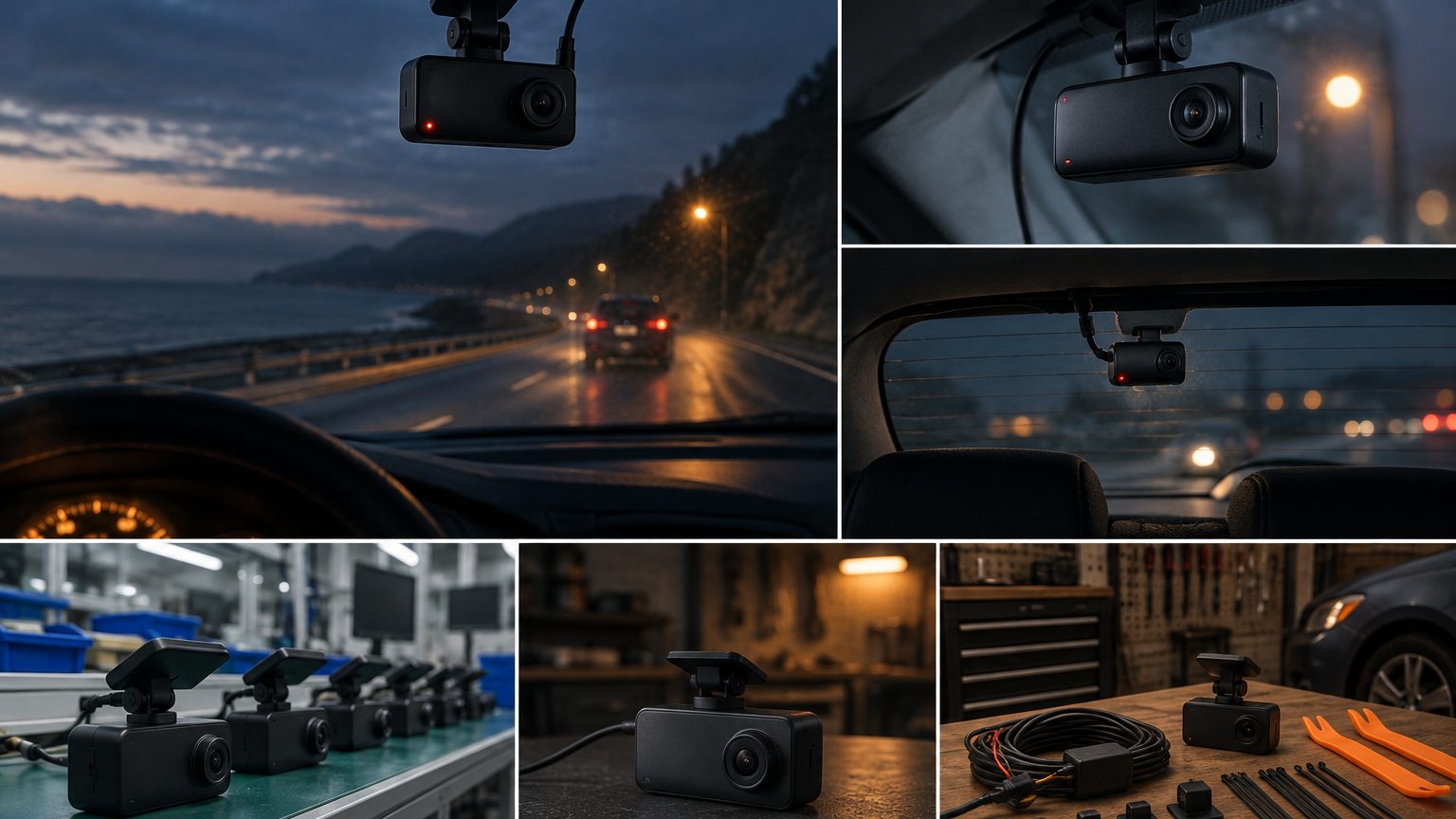
Installers judge a dash cam by what is in the box. Cable length, fuse taps, the cutoff setting of the hardwire kit, trim tools, adhesive mounts and spare parts decide whether the job takes twenty minutes or an hour. Parking-mode accessories add buffered recording when the car is off. The desk specifies these parts per vehicle type and checks the packed kit against the sheet. A supercapacitor in the recorder avoids heat problems in sun-baked cars. For shop workflow, the desk can also pack kits per vehicle class (sedan, SUV, van) so a bay technician picks the right cable lengths without opening every box, and can add a one-page install guide in your language to the carton, which cuts callbacks from first-time installers.
Consistency across reorders
The most expensive surprise for a distributor is a reorder that looks the same and differs inside: a substituted sensor, a different card, a firmware change. The golden sample is the defense. It is the approved unit kept as the reference, and bulk is inspected against it, including sensor model and firmware version. Where a component shortage forces a change, the desk reports it in writing with the options and the effect on timing rather than shipping it silently.
Customization and private label
Distributors usually want their own brand. Private label covers your logo on the housing and boot screen, your retail box, manual and warranty card, and is commonly published by Shenzhen OEM suppliers from about 100 pieces per model. App branding and firmware changes are quoted per project, and a new housing or mold is an ODM project priced per mold. See OEM and ODM and private label and packaging.
Papers, after-sales and logistics
Distributors in regulated markets need FCC, CE/RED, RoHS and, for installers working on commercial vehicles, E-mark reports. They come from the producing factory or lab and are verified by report number. After-sales questions - a faulty unit, a firmware issue - route through the desk to the partner factory, so the distributor has one contact. Mixed pallets and carton marks per branch or customer can be arranged, and bulk usually moves by sea with air for top-ups; see logistics.
Procurement path and lead time
Sample the three-tier ladder, run a small install trial in your own bay, approve a golden sample, and start with a first order sized to a quarter's sell-through. Samples ship in days from stock or about 7-15 working days when custom; stock-based reorders typically run about 15 working days and custom programs about 25-45 days. All are reference ranges confirmed in writing per program on MOQ and lead time. An illustrative example: an installer chain trials a hidden mini in three branches before adding it to every price list. Send the brief through the quote form.