
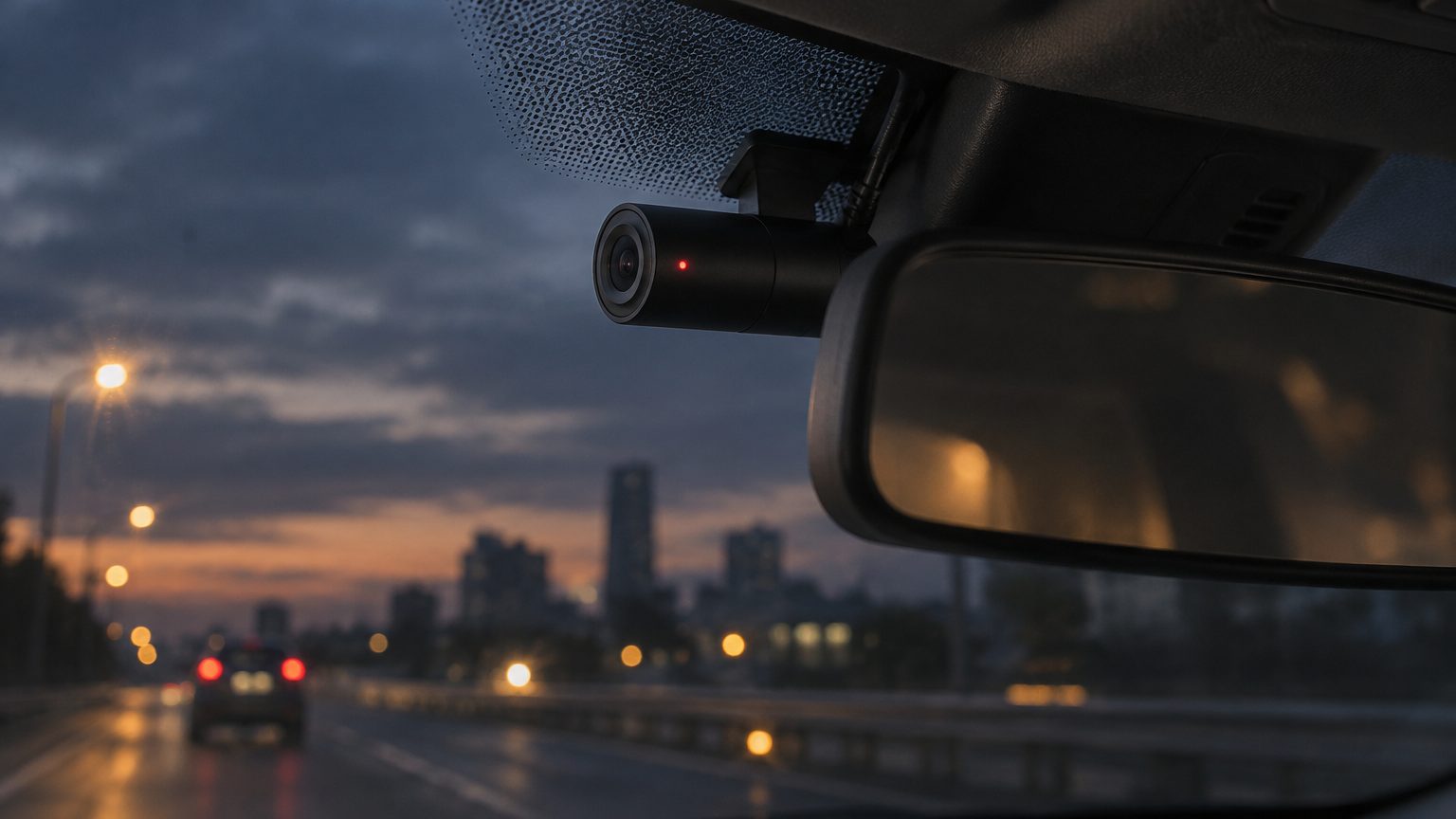
What a hidden mini dash cam is
A hidden or mini dash cam trades the big screen and wide body of a classic unit for a compact housing that tucks behind the rearview mirror. Many models have no display at all: you frame the shot and review footage through a phone app over WiFi, while a few keep a very small screen or just status lights. The attraction is practical. A small body is less likely to block the driver's view, draws less attention from outside the car, and looks like part of the cabin rather than an add-on. For a seller, that story is easy to explain in a listing and easy to photograph.
Search demand for this style is steady because the problem it solves is common: drivers who want evidence recording but do not want a device hanging from the glass. The desk treats it as a form-factor line rather than a resolution line, which is why it sits next to the mirror dash cam in most programs.
Typical platform and specs
Hidden models cover a range. Entry units run 1080P on a modest chipset, while higher tiers use a Novatek NT96670-class chipset with a Sony IMX415 sensor for native 3840 x 2160 recording. Some sold as "4K" use a 5-megapixel IMX335 and upscale, so the sensor line on the spec sheet matters as much here as on any other line; see true 4K vs upscaled 4K. Because the body is small, there is little room for a lithium battery and the heat it creates behind a sun-baked windshield, so a supercapacitor power buffer is the usual choice.
| Spec line | Typical range | What to confirm |
|---|---|---|
| Resolution | 1080P entry to native 4K on higher tiers | Sensor model, not only the box claim |
| Control | Phone app over WiFi, buttons, or tiny screen | App languages and branding options |
| Body depth | Compact; varies by lens module | Fit behind mirrors of common vehicles |
| Power buffer | Supercapacitor | Shutdown behavior after power loss |
| Storage | microSD, high-endurance recommended | Maximum card size supported |
| Heat | Small body, limited dissipation | Burn-in result in hot cabin conditions |
Variants buyers ask for
- Screenless app-only units. Smallest body, lowest visual impact; setup depends entirely on the app being well localized.
- Mini with a small display. Easier framing at install, slightly larger housing.
- Dual-lens minis. Front camera plus a small rear or cabin lens, for buyers who want more than one view in a compact kit.
- Integrated-look units. Shapes made to sit flush against the headliner, aimed at dealers and OEM-style accessory programs.
Audience and scenario
Three groups account for most orders. Online sellers use the line for drivers who care about appearance, often bundled with a high-endurance card. Installers and car-audio shops like it because a short cable run along the A-pillar makes a clean job, especially when paired with a hardwire kit. Dealers and corporate gifting programs use neutral black housings with a logo, because the product does not look out of place in a new vehicle. Rental and subscription fleets sometimes choose it where a visible camera would be removed or tampered with, though a visible camera can also deter misuse, so the choice depends on policy.
Customization
Logo on the housing and boot screen, retail box, manual and card inserts are the usual private-label steps. App branding, a changed icon set or a different default language list sit at the OEM level. Cable length and plug type (Type-C or mini USB) are worth settling early: a mini needs a thin, flat cable that routes under trim, and a cable that is too short or too stiff is the most common installation complaint. Shenzhen OEM suppliers commonly publish minimums from about 100 pieces per model for logo and packaging; app work and new housings are quoted per project and confirmed in writing.
Certification and legal notes
Models with WiFi are radio devices, so US sales need an FCC ID and EU sales fall under the Radio Equipment Directive, alongside CE EMC and LVD and RoHS; see certifications. Reports come from the producing factory or lab and are verified by report number. A separate point is law: some regions restrict where a device may sit on a windshield and how audio may be recorded. Rules vary by country and state; check local law before selling a concealed-style product.
Buyer checks before ordering
- Fit test. Mount a sample behind the mirror of two or three common vehicles and check view blockage and cable routing.
- Heat run. Ask for the burn-in result in a warm cabin, since small housings run hotter.
- App test. Pair, download and delete a clip in your target language.
- Card test. Run loop recording with the intended card size for a full cycle.
When the shortlist is clear, send quantities and branding needs through the quote form.