
The short answer: five families
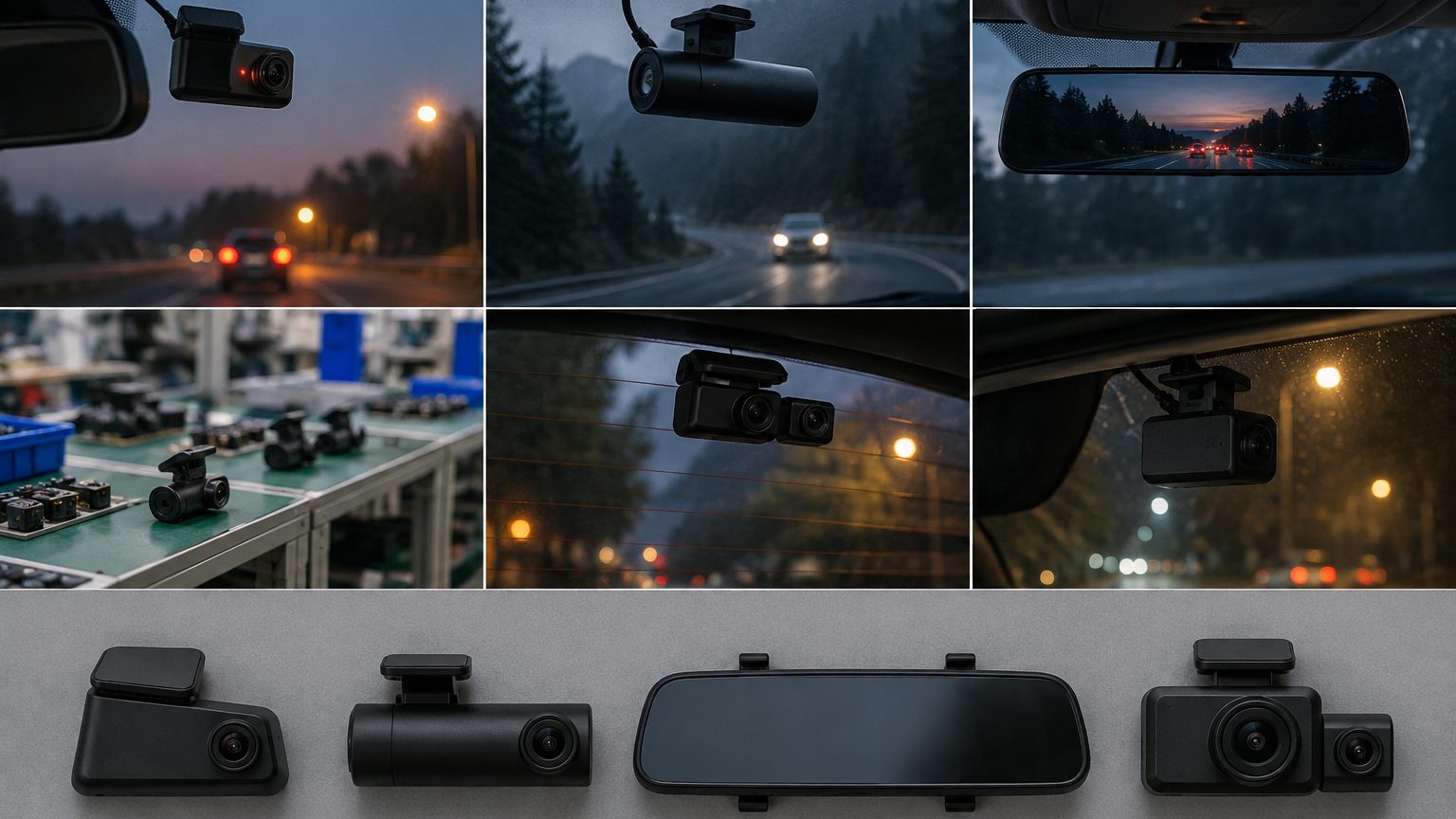
Most dash cams on the market belong to one of five families. Single-channel units carry one forward camera. Front and rear units add a second camera for the rear window. Front and cabin units add an infrared inward camera for the people inside the car. Mirror units put the camera and a large screen into a body that clips over the rearview mirror. Hidden or mini units are small, screenless and tuck in behind the mirror. Almost every other label you will see, such as wireless, 4K, GPS or night vision, describes a feature added to one of these five bodies rather than a separate family.
That distinction matters for sourcing. A buyer who treats "4K" and "dual" as separate product types ends up with a catalogue where the same housing appears three times under different names. A buyer who sorts by body first and feature second ends up with a cleaner range, fewer near-duplicate purchase orders and a support load that is easier to staff, because one platform means one set of instructions, one app and one failure pattern to learn.
Who each family suits
| Family | What it adds | Typical buyer | Main caveat |
|---|---|---|---|
| Single-channel | Forward recording only | Entry-level shoppers, gift bundles, first-time drivers | No record of what happens behind the car |
| Front and rear | Rear window coverage | Commuters, families, marketplace sellers building upgrades | Rear cable must be routed neatly |
| Front and cabin | Infrared interior view | Rideshare, taxi, driver training | Privacy notices and local rules apply |
| Mirror | Big screen, replaces the mirror view | Drivers who dislike windshield clutter, taxi and van users | Mounting and glare need checking per vehicle |
| Hidden or mini | Discreet look, app control | Premium cabins, installer shops | Needs WiFi and a phone to review footage |
Use this table as a first filter when a customer describes what they want in plain words. "I do not want to see it" points to hidden. "I want to see behind me" points to mirror or dual. "My drivers need protecting" points to cabin. The table also works in reverse when you plan a catalogue: if two of your listings attract the same buyer profile and the same objection, they are probably variants of one family and one of them is costing you attention.
Single-channel: the volume seller
A single front camera remains the simplest and most requested form. It is easy to explain on a listing, easy to install in minutes, and it forms the base platform from which most other families are derived: the same board, sensor and firmware appear again in dual and mirror versions. When you buy a single-channel unit, the sensor and chipset on the spec sheet decide quality far more than the resolution printed on the box. Our notes on true 4K and upscaled 4K explain why. For ready models in this family see the 4K dash cam and 1080P entry lines.
Because the single-channel unit is where new customers start, it carries a second job in your range: it is the review magnet. Entry buyers write the most reviews, so a stable, well-documented entry model quietly supports the ratings of everything above it.
Dual and cabin: more channels, more questions
Adding channels changes the cost, the install and the audience. A rear camera usually uses a 2MP sensor such as the GalaxyCore GC2053 class, which is adequate for plates at close range. A cabin camera adds infrared LEDs so the interior is visible at night. Read the dedicated notes on front and rear dash cams and three-channel units before choosing, because channel count drives cable length, power draw and the storage a card needs. It also drives the support ticket mix: most questions about multi-channel units are about cables and card capacity, not about image quality.
Mirror and hidden: two answers to the same complaint
Both families exist because many drivers do not want a camera dangling from the windshield. The mirror type solves it by turning the mirror into the device, which brings a large screen and often a rear camera. The hidden type solves it by shrinking the device until it disappears behind the mirror housing. The mirror dash cam note and the hidden dash cam guide cover the trade-offs in detail. Product pages: mirror dash cams and hidden and mini dash cams.
How channel count shapes cost and margin
Each added camera brings its own sensor, lens, cable and connector, so cost rises with channels while the failure surface grows too: more connectors, more cable runs, more installation time. For a reseller this cuts two ways. The price gap between a single and a dual unit is real but modest, while the perceived value of rear coverage is large, which is why dual sets usually carry the healthiest margin in a range. On the other side, every added channel increases the chance of an installation-related return, especially where customers fit the unit themselves. Budget for a clear instruction sheet, cable clips and a support page before you budget for marketing. Accessories then do the quiet work on margin: a hardwire kit and a high-endurance card attach to nearly every unit sold and rarely generate questions.
Features that cut across families
Beyond body style, features can be mixed into almost any family. WiFi lets a phone app download clips, GPS stamps speed and location on the footage, night-vision-enhanced sensors improve dark scenes, and parking mode watches the car while it is parked. Each feature brings its own certification or integration question: WiFi models need radio approval in each market, and GPS models need the antenna and map data to behave. The features do not change the family logic - a mirror unit with WiFi is still a mirror unit - but they decide which customers will shortlist it. Our WiFi and GPS lines show common combinations.
How to pick a range, not a product
A reseller does not need twelve products on day one. A sensible first range often has an entry single-channel unit, one front and rear dual set, and one specialist item such as a mirror or a hidden unit. That covers the main price tiers without creating three near-identical listings, and it keeps spare parts and documentation simple. Climate and market shape the mix as well: hot regions favor supercapacitor models in every family, app-minded markets push WiFi, and commercial customers ask about GPS and parking mode first. Demand supports this focus - industry reports estimate the 2025 global dash cam market at roughly USD 2.3 to 5.5 billion depending on definition, with commercial segments among the faster-growing parts - which is enough room for a specialist range of a few well-chosen bodies.
- Name the customer first: commuter, driver, operator or installer.
- Choose the body from the five families above.
- Add only the features that customer will actually use.
- Check certification for the market, especially for WiFi and vehicle use.
- Plan the accessories - kit and card - into the offer from the start.
- Request samples and confirm MOQ and lead time in writing.
What to send when you ask for a quote
A short brief saves several rounds of email. State the family, the number of channels, resolution, whether WiFi or GPS is required, the power method, the target market and whether you want your own logo or packaging. Typical terms published by Shenzhen OEM suppliers start private-label orders from about 100 pcs per model, but the real figure is confirmed in writing for each program. You can start the conversation through the quote form, or read MOQ and lead time first.