
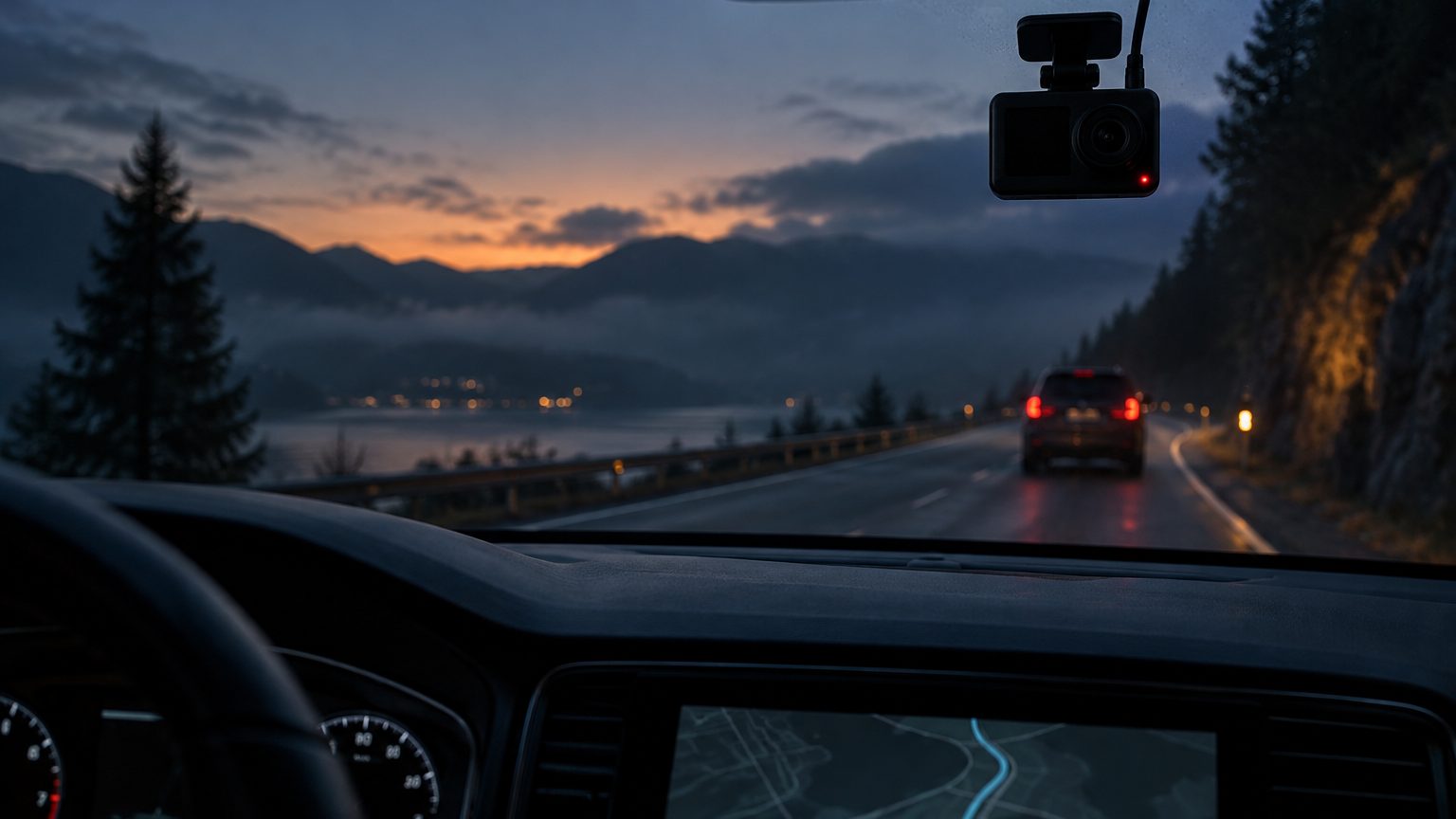
Why insurers and integrators buy dash cams
Industry reports on the dash cam market cite insurance requirements and accident evidence among the main demand drivers. For an insurer the logic is straightforward: a clip with a timestamp, a position and a speed can shorten a claim and clarify fault. For a telematics provider, the camera is one more data source that complements a telematics device. This page describes what a program built around that logic needs from the hardware. It does not describe pricing models, underwriting or claim processes, which are the program owner's business.
Lines that fit and why
The base is a GPS dash cam, which stamps speed and location on the footage. A WiFi app model lets a policyholder download an incident clip to a phone, and a 4K front camera raises the chance that plates and signs are readable. Programs that include rear coverage move to a dual-channel unit. For consumer-facing programs, the camera is usually bundled with a card and a simple plug-in kit; for managed programs, a hardwire kit makes the install permanent.
| Program type | Data needed | Hardware |
|---|---|---|
| Policyholder evidence program | Clip with time, speed, location | GPS + WiFi front camera, card, plug-in kit |
| Fleet insurance with camera requirement | Front and rear, parking events | GPS dual-channel, hardwire kit |
| Telematics integrator | Camera paired with a telematics device | GPS recorder, custom firmware |
| Promotional or loyalty program | Basic recording, branded device | 1080P or 4K, private label |
What the data is and is not
The platforms are standalone recorders. Footage and the GPS stamp are stored on the card; the policyholder or the installer retrieves a clip by WiFi or by reading the card. They are not live 4G devices and do not upload data automatically. A program that needs automatic upload, a driving score or live alerts requires a telematics device or a cellular unit beyond the scope of this catalog, scoped with an integrator. That clarity avoids a gap between what a program brochure promises and what the camera does. It also helps to define what a usable clip is before the pilot: a start time, an end time and a position that an adjuster can read without special software. File format, overlay layout and the player or app used to view the GPS stamp are therefore listed on the spec sheet, and sample clips are opened on the same tools the program's reviewers will use.
Privacy and legal considerations
A dash cam captures people and places, and an insurance program adds questions about consent, data retention and who may see footage. Rules on recording, audio, personal data and the use of video in claims vary by country and state, and some places restrict windshield mounting or audio capture. Treat this page as general information, not legal advice. Check local law and have the program owner's counsel review consent wording, retention periods and defaults. Firmware defaults such as audio off can be set in an OEM program once the policy is decided.
Customization: firmware and app
Programs that put their name on the device go beyond a logo. A branded boot screen, a branded app with a custom language list, preset recording options and a locked menu are all firmware and app customizations, quoted per project and confirmed in writing. They carry higher minimums than logo-only private label. See firmware and app customization and OEM and ODM.
Paperwork
A device distributed to policyholders in several markets needs the right papers: FCC ID for WiFi models in the US, CE with the Radio Equipment Directive in the EU, RoHS, and UKCA for the UK. Reports come from the producing factory or lab and are verified by number; Roadtrace holds no certificates. Confirm with a compliance adviser. See certifications.
Procurement path, MOQ and lead time
Insurance programs typically begin with a pilot cohort. The sequence is: spec sheet and data requirements, custom samples in about 7-15 working days, a pilot with a small group, a golden sample, then bulk in about 25-45 days for custom firmware or about 15 working days for a stock platform. Private label starts from about 100 pieces per model as a typical reference, with firmware and app branding set higher per program. Everything is confirmed in writing; see MOQ and lead time. An illustrative example: a regional insurer pilots a branded GPS-WiFi camera with a few hundred volunteers before wider rollout. Start with the quote form.