
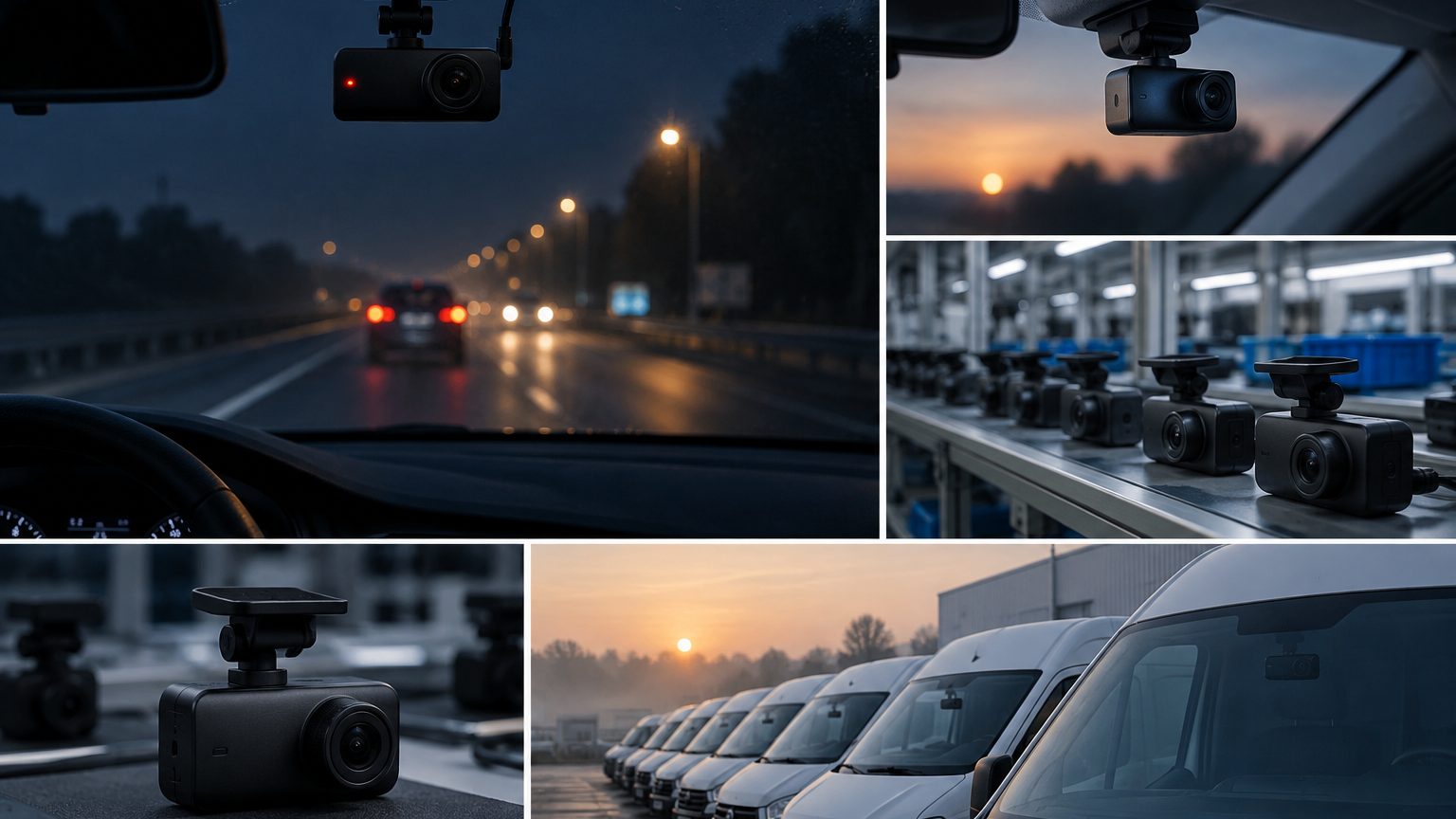
The fleet buyer's real problems
Fleet operators rarely buy a dash cam because it is interesting. They buy to reduce disputed claims, to coach drivers with real footage, to settle "who hit whom" quickly, and sometimes because an insurer or a customer contract asks for it. Industry reports cite fleet safety and insurance requirements among the main drivers of dash cam demand. The pain points that follow are practical: footage that cannot be found, units that fail in summer heat, cables that get pulled out, and a rollout that depends on one installer who knows the trick. A good fleet program is designed around these, not around the headline resolution.
Which product lines fit and why
Most fleet programs combine two or three lines. A GPS dash cam stamps speed and location on the footage, which turns a clip into evidence that lines up with a route record. A 4K front and rear system covers rear-end collisions, the most common fleet dispute, with a native 4K front camera and a 1080P rear. Where drivers also need cabin evidence, the front plus cabin infrared line adds an inward channel. Every unit is paired with a hardwire kit and a high-endurance microSD card.
| Fleet type | Typical channels | Features to specify | Lines |
|---|---|---|---|
| Delivery vans | Front + rear | GPS stamp, parking mode, G-sensor lock | 4K front and rear, GPS |
| Service and utility vehicles | Front, optional rear | Hardwire cutoff, wide temperature handling | 4K single or GPS |
| Sales cars and pool cars | Front | Simple install, WiFi download | WiFi app, 1080P entry |
| Passenger shuttles | Front + cabin IR | Infrared cabin camera, audio policy | Rideshare line |
Channels, GPS and what 4G means here
The platforms in this catalog are standalone recorders with loop recording, G-sensor event lock, optional GPS and optional WiFi for app download. They are not live-streaming 4G units, and the desk does not describe them as such. Fleets that need live video over a cellular link are a different product class and are scoped separately with a telematics integrator. For most fleets, the practical workflow is simple: footage stays on the card, an event is pulled over WiFi or by swapping the card, and the GPS stamp links the clip to a route record.
Installation and power
Hardwiring is what separates a fleet install from a consumer one. A hardwire kit takes power from the fuse box, adds a low-voltage cutoff to protect the vehicle battery, and enables buffered parking mode. Cable length per vehicle type, fuse tap type and cutoff voltage are fixed on the spec sheet before bulk so every installer uses the same parts. Supercapacitor models are preferred for heat tolerance, and for commercial vehicles the desk asks the factory for E-mark (UNECE R10) reports where the market requires them. See certifications.
Data and privacy
Footage of drivers, passengers and other road users is personal data in many places. Rules on recording, audio capture, retention and notice to employees vary by country and state, and some jurisdictions restrict where a camera may be mounted on the windshield. Treat this as general information and check local law and employment rules before deployment. Practically, fleets decide retention periods, who may view clips, and whether audio recording is switched on at the firmware level; the desk can set defaults in an OEM program once you decide.
Customization for fleets
Private label gives the fleet or the integrator a branded camera: logo on the housing, boot screen, gift box or bulk carton, and manual. Firmware and app changes - a default audio setting, a locked menu, a preset resolution - move the program into OEM territory and are quoted per project. See firmware and app customization.
Procurement path and reference ranges
- Pilot sample. Stock samples ship in days; custom samples take about 7-15 working days.
- Field trial. Mount in a handful of vehicles for a few weeks across day, night and heat.
- Golden sample. The approved unit becomes the reference for bulk inspection.
- Bulk. Stock-based platforms typically run about 15 working days; custom programs about 25-45 days after sample approval.
Private label minimums are commonly published from about 100 pieces per model by Shenzhen OEM suppliers, and every figure is confirmed in writing per program. An illustrative example: a regional courier fleet might pilot ten vehicles, fix the cable lengths and cutoff voltage, then place the bulk order against the golden sample. Details are on MOQ and lead time; start a brief with the quote form.
Logistics. Bulk fleet orders usually go by sea from Yantian or Shekou for planned rollouts, or by air for pilots and top-ups, with typical ranges listed on logistics. Supercapacitor models avoid lithium battery shipping restrictions. Cartons can be marked per depot or per vehicle batch so installers receive kits in the order they are fitted.