
How to read an equipment list
Equipment lists on supplier sites are easy to write and hard to check. A long list proves little by itself; what matters is whether the equipment matches the product, whether it is maintained, and whether the factory keeps records from it. The categories below describe what a dash cam partner factory in Shenzhen typically runs. They are typical equipment found at partner factories, confirmed per factory during audit, and the desk does not describe any of it as its own. Roadtrace is a sourcing desk; the machines belong to the factories.
Board-level equipment
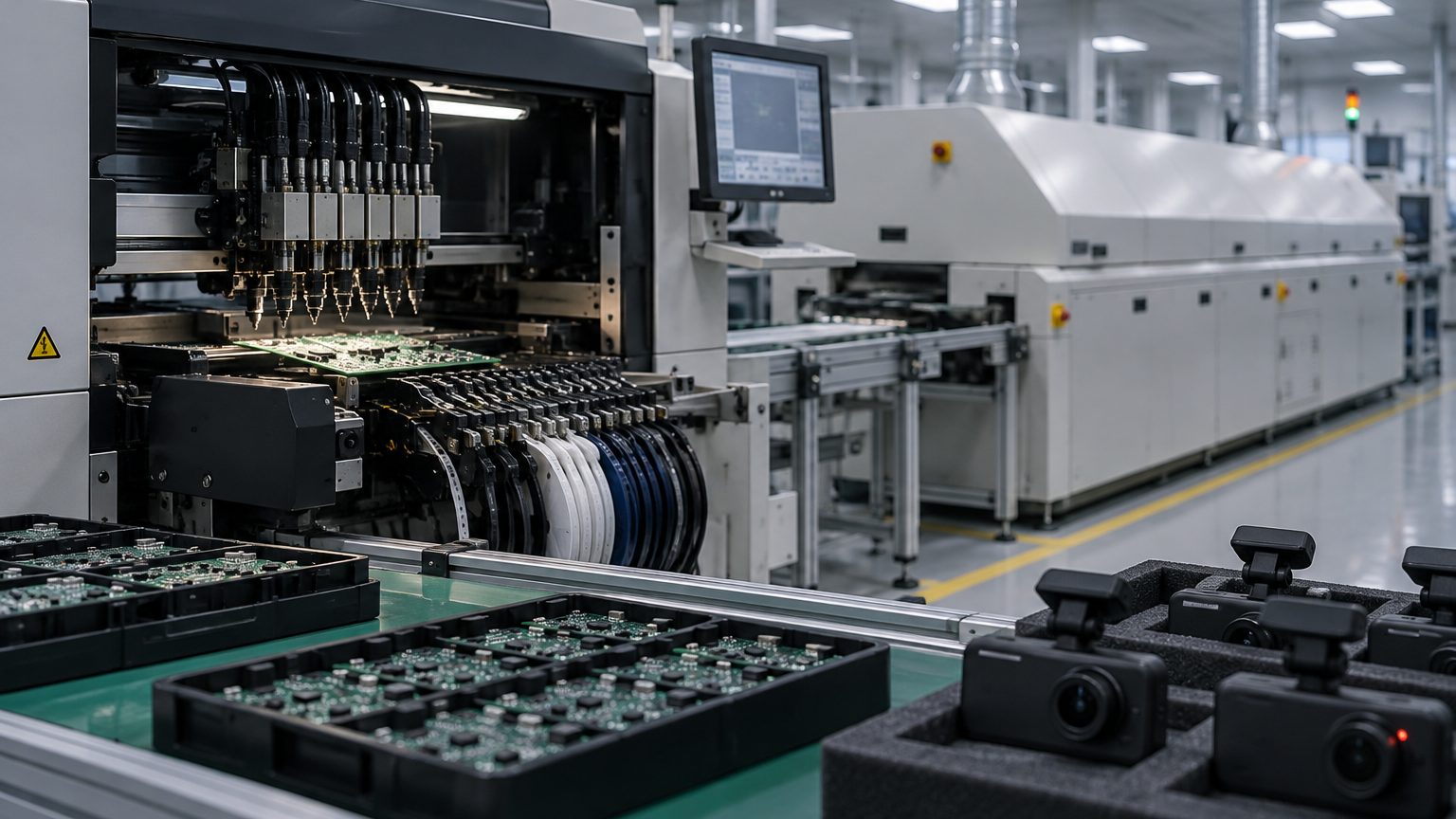
Dash cam boards are small and dense, which makes the SMT line the first station that decides yield. A typical line includes a solder paste printer, a pick-and-place machine sized for small components, and a reflow oven with a controllable temperature profile. After reflow, automated optical inspection (AOI) checks placement and solder joints before the board moves on. Some factories subcontract this stage to a board house; that is acceptable if it is declared in the factory profile and the incoming boards are inspected.
| Station | What it does | What the desk asks |
|---|---|---|
| Solder paste printer | Applies paste to board pads | Stencil control, paste storage |
| Pick-and-place | Places small components | Component size range, feeder checks |
| Reflow oven | Melts solder in a set temperature profile | Profile record per product |
| AOI | Optical check of placement and joints | Defect records and rework route |
| Rework bench | Corrects faulty boards | Whether reworked boards are tracked |
Camera-specific stations
These stations are what separate a dash cam factory from a general electronics assembler. A lens focus calibration station holds the module in front of a resolution chart and adjusts focus before the lens is fixed; without it, sharpness varies from unit to unit. A light box or chart set supports checks of color and brightness. Burn-in racks run units on continuous recording for a period set per program, which exposes early failures in cards, heat and firmware. Functional test fixtures then verify recording, GPS lock, WiFi pairing, the G-sensor and buttons in a repeatable way, so the result does not depend on one operator's eye. The production process shows the order of these stations.
Environmental and mechanical testing
Dash cams live on a hot windshield, so a partner factory should be able to run thermal tests, at least on a sampling basis. Typical equipment includes a high and low temperature chamber and a drop or vibration test setup for packaging and housings. Test conditions are agreed per program and recorded in the report; the desk does not quote temperatures or durations the factory has not documented. See quality control for how these tests fit the inspection plan.
Packing and support equipment
Packing lines need less technology but still affect returns. Look for a labeling and barcode printing setup for carton marks and marketplace warehouse labels, a clean area for final inspection and a storage area for components that is controlled for moisture. Static-safe handling, such as grounded benches and wrist straps, matters at board and assembly stages. Firmware flashing stations should keep a version record so that a batch can be traced back to the build that went on it.
What to ask during an audit
The audit is where the equipment list is turned into evidence. The checks the desk uses are short and consistent.
- Which stations are in the building, and which are subcontracted?
- Are calibration and maintenance records kept for the focus station, test fixtures and chambers?
- Does the factory keep per-batch records for burn-in and functional test?
- Can the factory show a recent sample of its own inspection reports?
- Is firmware version control in place for flashing?
Visits and third-party audits can be arranged for confirmed programs, and the answers go into the factory profile described on the sourcing network page.
Matching equipment to your program
A plain 1080P entry model needs less than a 4K dual-channel unit with GPS and WiFi, and a program that adds a new housing depends on tooling capacity that is entirely separate from the assembly line. Tell the desk the line and the markets on the quote form, and the shortlist comes back with the equipment points that matter for that specific model.