
The short answer
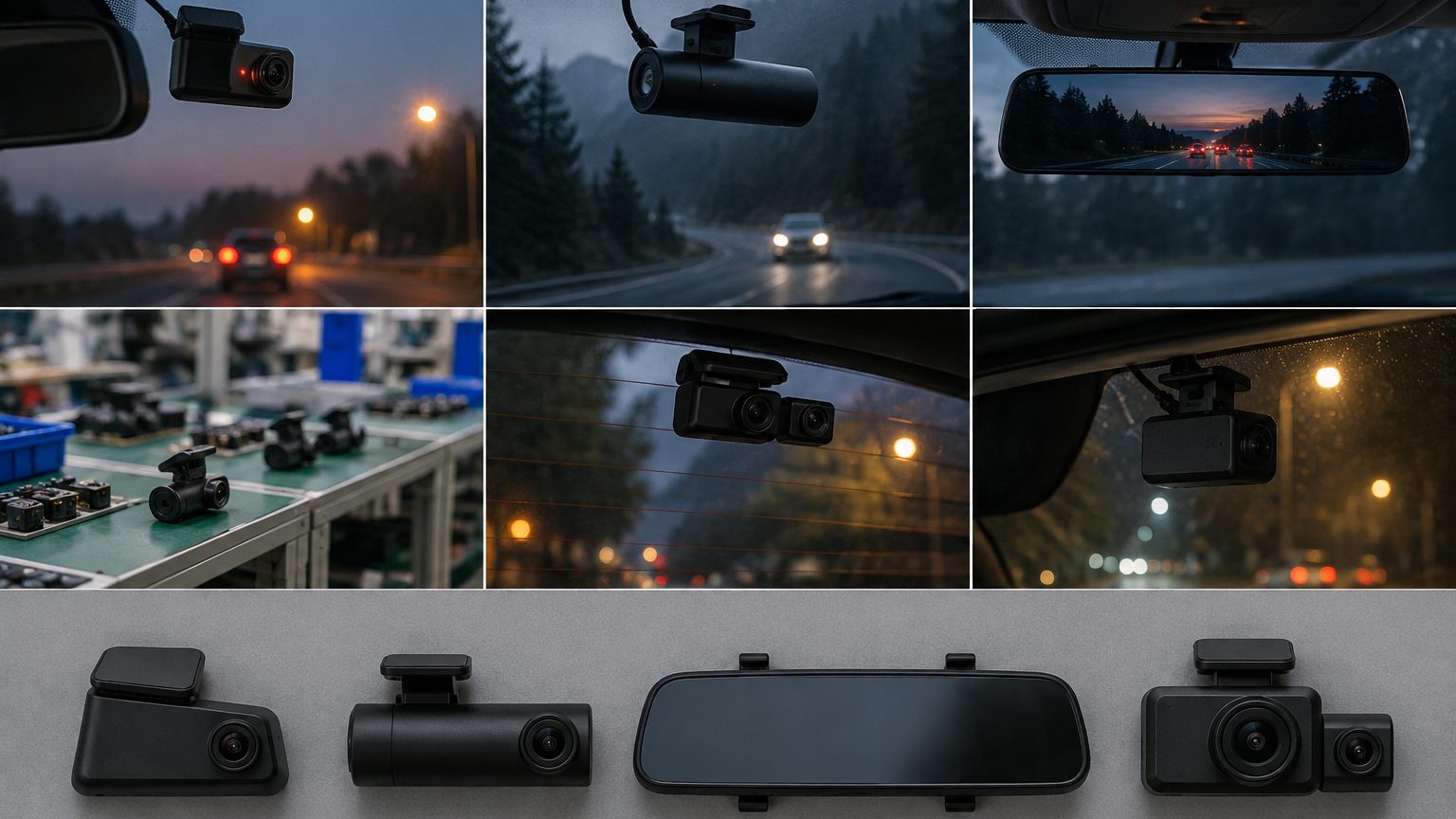
OEM-style dash cam is a loose term. In the car trade OEM means original equipment manufacturer, and an OEM-style dash cam is one that imitates the look of a factory-fitted camera: a compact body that sits tight behind the mirror, a color and finish matching the interior trim, and a cable that disappears into the headliner and A-pillar. It is not a statement about who made it. Confusingly, the same abbreviation also describes the manufacturing arrangement where a factory builds a product that another company sells under its own brand. Buyers should keep the two meanings apart: one is about appearance, the other is about the supply model.
Both meanings matter to the people we serve. Dealers and installers want the first, because they sell a clean integrated look. Resellers and brand owners want the second, because they need a product under their own name. Sometimes they want both, and a partner factory can often deliver the combination.
What gives a dash cam an integrated look
| Element | What it looks like | Sourcing question |
|---|---|---|
| Compact housing | Small, low-profile, flush behind the mirror | Sizes, mounting angle, glass contact |
| Matte finish | Dark, non-reflective, matches trim | Colors and surface options |
| Hidden cable | Runs under trim into the fuse box | Hardwire kit and connector type |
| No screen or small screen | No glowing display at night | App control and WiFi approval |
| Quiet interface | Subtle indicator light, discreet prompts | Firmware settings for lights and sounds |
This list closely resembles the hidden and mini dash cam family, and in fact the two overlap. An integrated look is a design goal, while hidden and mini is a product form; the same ready model can serve both descriptions.
Who asks for it
- Car dealers selling accessory packages at vehicle delivery, who need a camera that looks as if it belongs to the car.
- Installer shops offering a premium fitted service with neat wiring and a fixed price.
- Fleet managers who want a uniform look across vehicles and mounting that resists tampering.
- Rental and subscription operators who want customers to leave devices alone and plugged in.
For dealers, see car rental and dealers. For shops and distributors, see distributors and installers. Each of these audiences buys the same hardware for a different reason, so agree on which one you are serving before you compare models.
Dealer and installer economics
An integrated-looking camera sells differently from a boxed retail unit. At a dealership it is an accessory attached to a car purchase, where the buyer is already spending and the neat result is part of the value, so the camera price carries less resistance. At an installer shop it anchors a service: device, hardwire kit and labor in one line. In both cases the recurring value is the relationship - the customer who trusts the fit returns for the next vehicle or recommends the shop. That is why presentation matters more here than raw feature count, and why a modest camera installed cleanly beats a feature-heavy camera installed with visible cables and a dangling plug.
What customization is realistic
A partner factory in Shenzhen can adjust several layers, but each has a different effort and minimum quantity. Logo and packaging changes are the lightest. Firmware changes, such as startup tone, indicator colors and app name, are heavier. A new housing needs tooling, quoted per project with its own lead time. The honest rule is: the deeper the change, the higher the quantity and the longer the schedule. Typical terms published by Shenzhen OEM suppliers start private-label orders from about 100 pcs per model, while firmware branding and new molds are confirmed per program. Read OEM and ODM for the route options and OEM vs ODM for how responsibility changes.
Where integrated looks go wrong
An integrated look should never hide a weak product. Small bodies leave less room for heat dissipation, so check the supercapacitor and operating temperature. A hidden camera angle may be partly blocked by the mirror housing or a tinted band, so test the field of view on real windshields, at the actual mounting position, before approving a model. Quiet firmware is good, but a camera that gives no sign of recording can confuse owners and generate calls; a subtle indicator is a compromise worth specifying. And a smart look is wasted if the app is slow or unreliable, since this family leans on the app for all settings. Request sample footage and test the app on several phones, as covered in the WiFi and app note.
Tamper resistance and fleet fit
Integrated looks have a practical side for fleets: a camera that is tucked behind the mirror, hardwired and trimmed in is harder to unplug, reposition or steal than a 12V-socket unit on a suction cup. Drivers know it is there, but it does not invite casual interference, and the uniform placement across vehicles makes review and comparison easier. Fleet buyers should still tell drivers what is recorded and why - transparency reduces disputes and keeps the program running smoothly. See fleet dash cam solutions for the program view.
Installation as part of the product
For this segment the install is part of what the customer buys. The finished result depends on a hardwire kit with a fuse tap that suits the vehicle, a low-voltage cutoff set to protect the battery, and the care of whoever routes the cable. Installers appreciate a kit that includes trim tools, spare fuse taps and clear instructions. See hardwire kits and installation kit options.
Checklist for a dealer or installer program
- Define the look: size, color, screen or no screen.
- Choose the platform: sensor, chipset and codec, named on the spec sheet.
- Choose the power path: 12V socket, hardwire kit or both.
- Confirm market certification: FCC, CE/RED and, for commercial vehicles, E-mark.
- Agree on branding level: logo only, packaging, firmware, app.
- Approve a sample fitted to a real vehicle, then place the order with written terms.
The desk coordinates this sequence with partner factories and checks samples before bulk. Share vehicles, markets and target look through the quote form.