
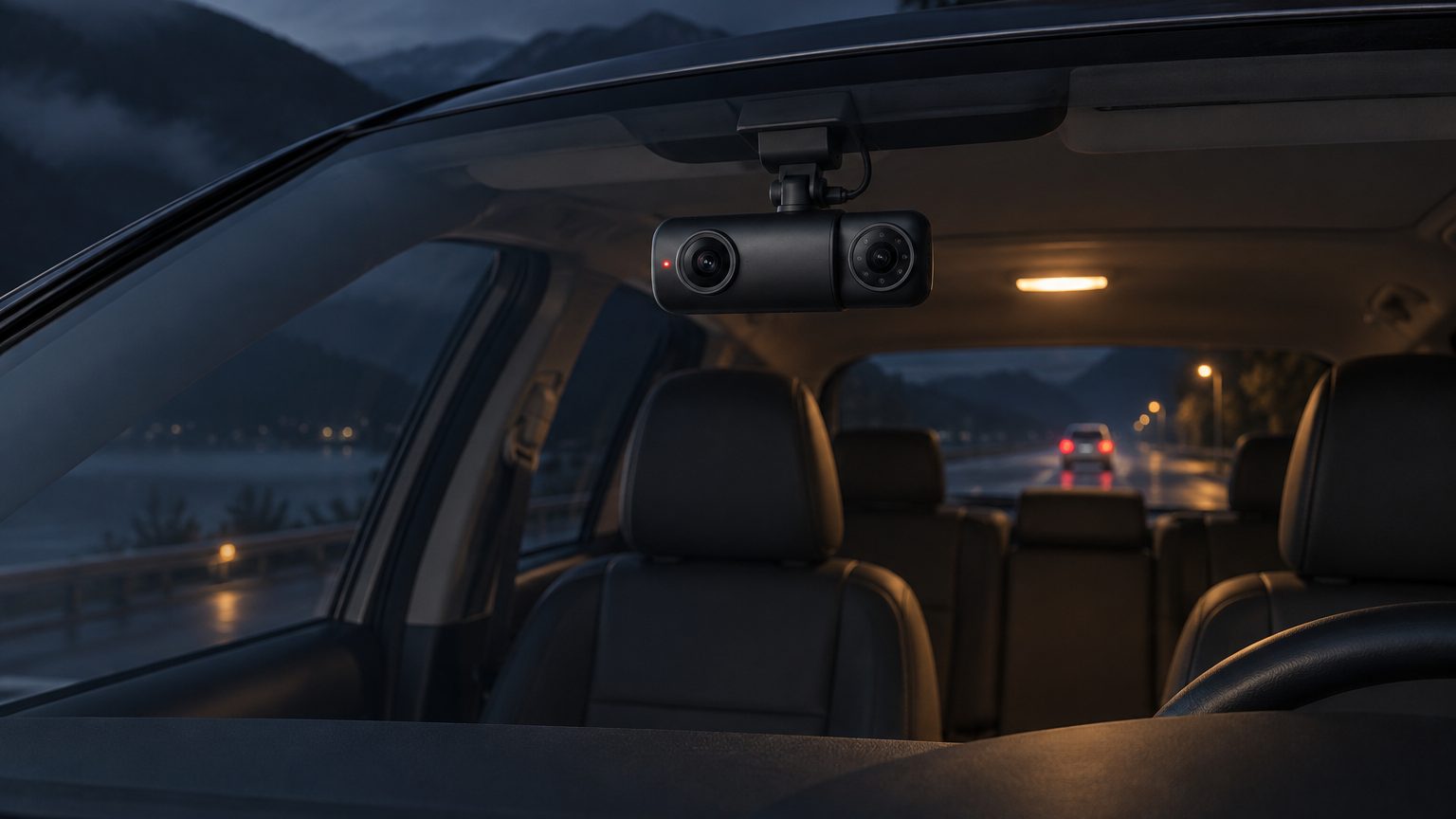
What a rideshare dash cam is
A standard dash cam looks forward. A rideshare model adds a second lens that faces the passenger cabin, ringed with infrared LEDs so the image stays usable when the cabin is dark. Both streams are written by one recorder to one card, with time-synced files. For a driver, that means evidence of what happened on the road and inside the car, from a single device and a single power cable. For an operator, it means a consistent platform across hundreds of vehicles and a single app to train on.
The line sits between the plain front-and-rear system and the night-vision line: the cabin lens is aimed inward rather than backward, and the infrared is part of the design, not an add-on.
Typical platform and specs
Most units pair a Novatek-class chipset with a front sensor ranging from 1080P to native 4K and a 2-megapixel GalaxyCore GC2053-class sensor for the cabin camera at 1080P. Infrared on the cabin lens means the image turns monochrome in the dark, which is normal and not a fault. Resolution matters less inside the car than front-lens quality, but lens angle matters a great deal: a cabin lens must cover the rear seats of a sedan without cutting off door panels in an SUV.
| Spec line | Typical platform | What to confirm |
|---|---|---|
| Front channel | 1080P to native 4K | Sensor model and dual-mode frame rate |
| Cabin channel | 1080P, GC2053 class, infrared LEDs | Field of view and IR range in a real cabin |
| Audio | Microphone with on/off control | Default state and a clear mute option |
| Power | 12V vehicle input, hardwire option | Low-voltage cutoff for all-day drivers |
| Storage | microSD, high-endurance class | Card size versus hours of two-channel recording |
| Extras | GPS stamp, WiFi app, event lock | App language list and file export |
Variants
- Two-channel (front + cabin). The core rideshare product and the easiest to explain.
- Three-channel (front + cabin + rear). For operators who also want rear collision evidence; see the three-channel guide.
- Mirror-format units. The cabin camera is built into a mirror-style body for a cleaner look.
- Fleet versions. Same hardware with GPS, locked settings and a branded app for operators.
Audience and scenario
Individual drivers buy for protection against disputed trips and damage claims. Taxi and ride-hailing operators buy in volume, often wanting the same unit in every vehicle, a locked configuration and a clear storage policy. Driver communities and associations resell to members, and car rental or subscription fleets use the cabin lens to document vehicle condition between rentals. Online sellers serve the first group; the rideshare and taxi solutions page covers the operator side.
Privacy and audio: general information
This is the one line where law shapes the product. Rules on recording passengers, posting notices inside the vehicle, and capturing audio vary by country and state, and platforms or operators may add their own policies. The desk gives general information only and does not offer legal advice; check local law and the rules of the platform you drive for. In practice, programs often ship with the audio switch clearly labeled, a manual that tells drivers to notify passengers where required, and an optional decal inside the packaging. Read more in the rideshare dash cam guide.
Installation notes for operators
Cabin cameras work best when mounted close to the mirror, angled to cover the rear bench without pointing at the driver's face. Cables should run along the headliner and A-pillar so that nothing hangs near the airbag area. Operators rolling out many vehicles benefit from a one-page install card with the same steps for every model, and from a label on each unit that records the vehicle it belongs to. These small habits shorten rollout time and make later card swaps routine.
Customization and paperwork
Private label covers logo, retail box, manual and a passenger notice insert. Operators often want app branding, a fixed default configuration, and a cable length tuned to the vehicle model. WiFi units need an FCC ID in the US and fall under the Radio Equipment Directive in the EU; commercial-vehicle programs may also ask for E-mark (UNECE R10) documents. Reports come from the producing factory or lab and are verified by number. Shenzhen OEM suppliers commonly publish minimums from about 100 pieces per model; typical ranges are confirmed per program on MOQ and lead time.
Buyer checks before ordering
- Cabin clip. Review night footage from the actual cabin, not a sales sample clip.
- Audio test. Confirm the switch works and the default is what you intend.
- Glare check. Infrared reflecting off glass or a dashboard can wash out the front or cabin image.
- Storage math. Calculate hours of two-channel recording on the intended card size.
Send vehicle types, markets and quantities through the quote form for a written shortlist.